

Discover the role of music in themed parties to energize kids' events in Melbourne. Use our proven tips to create engaging experiences!
Role of music in themed parties: a Melbourne parent’s guide
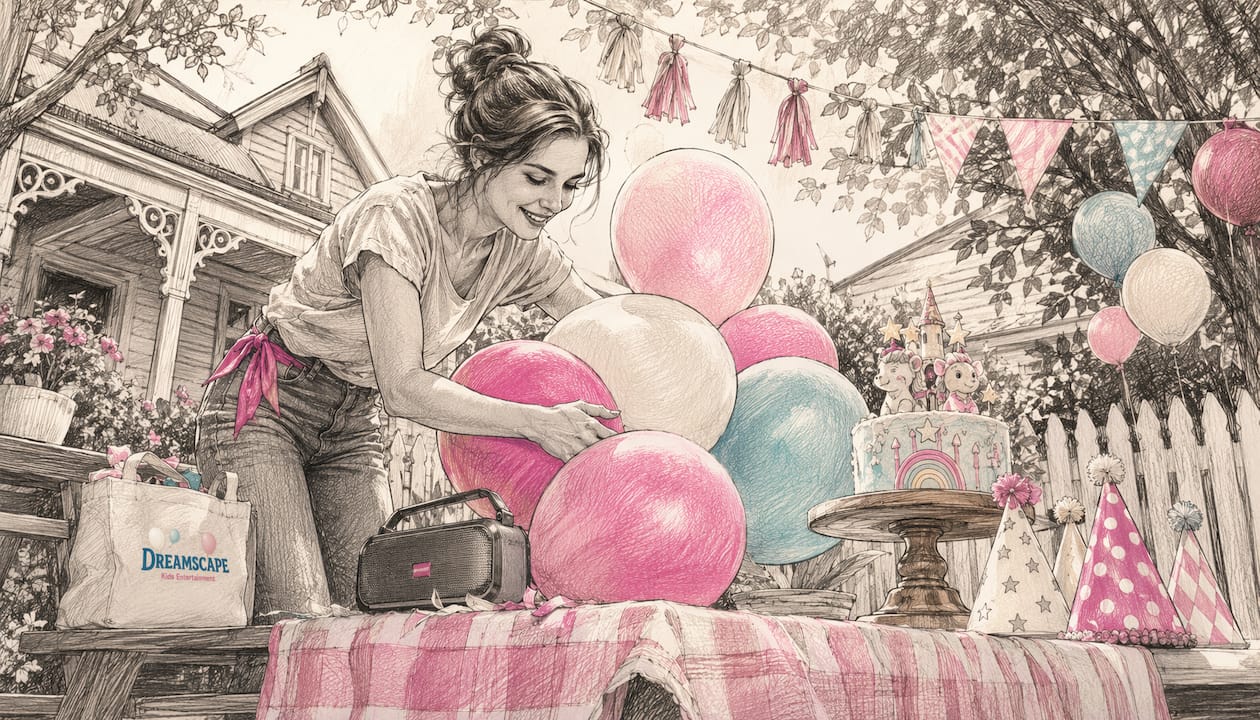
Music is the single most powerful tool you have at a kids’ themed party. Use it to control energy, reinforce the theme, and drive active engagement - and you’ll need far fewer verbal instructions to keep 15 excited children on track. The three-phase structure that works best is calm, familiar tracks for Arrival, high-energy theme-matched songs for Game Time, and gentle wind-down music before cake and goodbyes.
Quick planning checklist:
- Arrival (0-20 min): Soft, recognisable kids’ tracks at low volume - think Wiggles, Disney instrumentals, or theme-adjacent background music.
- Game Time (20-80 min): Upbeat, theme-matched songs that cue movement; switch tracks to signal activity changes.
- Wind-Down (80-120 min): Slower tempo, familiar lullaby-style or acoustic covers to settle energy before food and cake.
Research on joint music-making and observational studies in early childhood settings back this up, and Dreamscape’s entertainers have applied it across Melbourne for over 25 years.
Table of Contents
- Why does music matter so much at kids’ parties?
- How to structure your party soundtrack in three phases
- How do you pick the right songs for your theme and age group?
- Musical activities that get kids moving and cooperating
- Practical setup and safety: what you actually need
- What should you ask before hiring a kids’ entertainer or DJ?
- Key takeaways
- Why music sits at the heart of every Dreamscape party
- Dreamscape brings music-led themed parties to Melbourne families
- Useful sources
- FAQ
Why does music matter so much at kids’ parties?
Active musical engagement - joint singing, dancing, playing instruments together - increases prosocial behaviour in 4-5-year-olds, producing more spontaneous helping, sharing, and interpersonal synchrony than non-musical play. That’s not a soft benefit. It means a well-chosen playlist actively reduces conflict and boosts cooperation without you having to referee.
Finnish early childhood observational research found that groups where music was emphasised showed more sustained, intense engagement and stronger wellbeing indicators than those where it wasn’t. Classroom studies also show music aids attention and emotional regulation in early years settings - both of which matter enormously when you have a room full of sugar-fuelled five-year-olds.
“Children prefer other children whose favourite songs are familiar to them. Shared knowledge of specific songs may be a powerful determinant of children’s social preferences.” - PMC / Sage Journals, shared cultural knowledge study
That finding has a direct practical implication: play songs the kids already know. Familiar Australian tracks - The Wiggles, Justine Clarke, or a well-known Disney soundtrack - create instant social comfort. Children who recognise a song feel like they belong, which is exactly the atmosphere you want in the first 20 minutes of a party.
How to structure your party soundtrack in three phases
A three-phase soundtrack smooths every transition and removes the need for constant verbal direction. Here’s how it maps to a standard two-hour party.
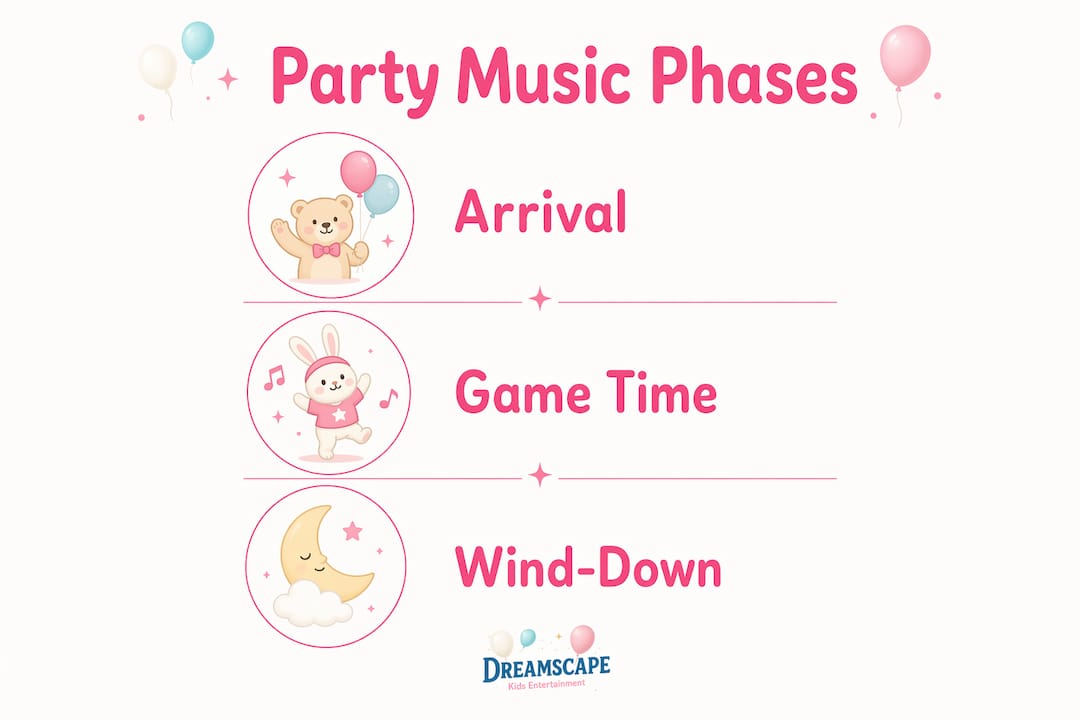
| Phase | Timing | Energy goal | Track types |
|---|---|---|---|
| Arrival | 0-20 min | Calm, welcoming | Soft Disney, Wiggles, acoustic kids’ covers |
| Game Time | 20-80 min | High energy, theme-matched | Superhero scores, pop anthems, dance tracks |
| Wind-Down | 80-120 min | Settling, predictable | Gentle instrumentals, slow-tempo kids’ songs |
For a superhero party, Game Time might open with the Avengers theme, shift to upbeat pop for freeze dance, then use a recognisable wind-down track - the same one every time - as a non-verbal cue that food is coming. Kids learn that cue fast.
Playlist snippets for a 2-hour party:
- Arrival: “Hot Potato” (The Wiggles), “You’ve Got a Friend in Me” (Toy Story), soft instrumental Disney medley
- Game Time: “Avengers Theme” (Alan Silvestri), “Can’t Stop the Feeling” (Justin Timberlake), “Happy” (Pharrell Williams), “Roar” (Katy Perry)
- Wind-Down: “Rainbow Connection” (acoustic), “Somewhere Over the Rainbow” (ukulele cover), gentle nature soundscapes
Pro Tip: Start every song at the chorus, not the intro. Kids’ attention locks in at the hook - a 30-second intro is 30 seconds of fidgeting. Short edits keep energy high and reduce waiting boredom.
How do you pick the right songs for your theme and age group?
The rule is simple: prioritise recognisable, clean tracks that match the theme and the age group. A five-year-old at a princess party needs “Let It Go,” not an obscure orchestral piece. An older primary kid at a K-Pop party wants current chart-friendly tracks they’ve actually heard.
Theme-matched playlist starters:
- Superheroes: Marvel/DC film scores, “Superman” (Black Lace), “Eye of the Tiger”
- Princesses/fairies: Disney princess soundtracks, “A Whole New World,” Justine Clarke’s gentler tracks
- Jungle/animals: “The Lion Sleeps Tonight,” “I Like to Move It” (Madagascar), animal-sound percussion tracks
- K-Pop inspired (older kids): BTS “Dynamite,” BLACKPINK “How You Like That,” age-appropriate K-Pop covers
For inclusive choices, mix in tracks from diverse cultural backgrounds - a Bollywood-inspired dance number or a Pacific Islander children’s song can make a multicultural group feel seen. Australian-produced kids’ music from acts like Diver City reliably prompts movement and sing-alongs at mixed-age gatherings.
Age-based guide:
- Preschool (3-5): Short, repetitive songs with actions; avoid anything with complex lyrics or scary themes.
- Early primary (6-8): Disney hits, pop anthems, call-and-response songs; introduce freeze dance and musical chairs.
- Older primary (9-12): Current chart hits, K-Pop, nostalgic early-2010s pop; let them vote on a song or two.
Mix in one or two parent-friendly nostalgic hits - “Dancing Queen,” “September” by Earth Wind & Fire - and the adults stop standing awkwardly at the edges and start joining in.
Pro Tip: A personalised song that mentions the birthday child’s name is a guaranteed crowd moment. Several providers offer custom tracks; even a simple name-drop in a familiar melody gets an enormous reaction from younger kids.
Musical activities that get kids moving and cooperating
Active musical engagement increases prosocial behaviour - so the more kids are doing music together, not just hearing it, the better the party dynamic. These four activities work across age groups and need minimal equipment.
- Freeze dance: Play a high-energy track; when the music stops, everyone freezes. Eliminate the last person to freeze or just play for fun with younger kids. Works best in 3-minute rounds.
- Pass the beat: Sit in a circle, clap a rhythm, pass it around. Add complexity for older kids (change tempo, add a second rhythm). Builds focus and turn-taking.
- Sing-along with actions: Choose a song with clear, repeatable actions (“Head, Shoulders, Knees and Toes,” or a theme-specific version). Lead the actions; kids mirror. Great for the first 10 minutes when not everyone has arrived yet.
- Mini-instrument parade: Give kids shakers, tambourines, or clapping sticks and march around the room to a theme track. Costs almost nothing; the noise level is joyful, not chaotic.
For younger kids (3-5), keep each activity under five minutes and use the same familiar song each time so they know what’s coming. Older kids (8-12) can handle longer rounds and enjoy party games with a competitive element.
Pro Tip: For karaoke or sing-along moments, jump straight to the chorus. A full intro kills momentum. Keep each clip to 60-90 seconds for under-7s; older kids can handle a full verse-chorus-verse.
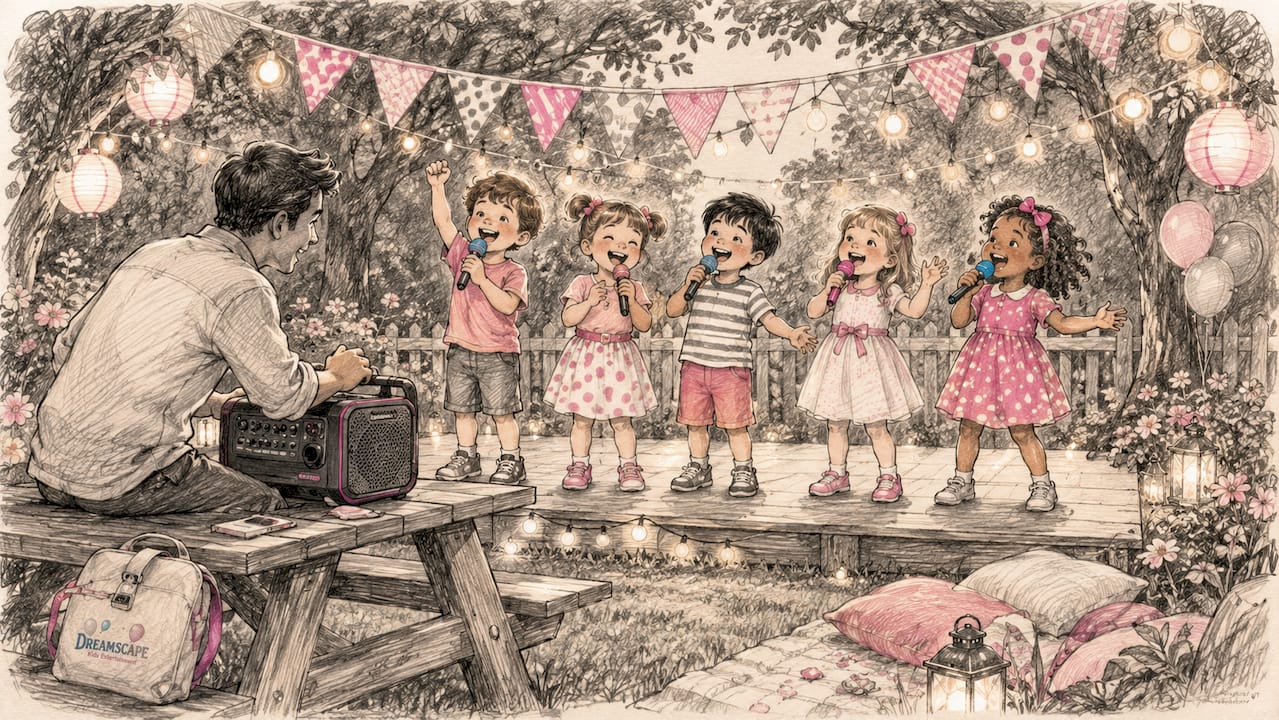
Practical setup and safety: what you actually need
Sound setup should balance clarity with safe volume, and you need a backup plan before the party starts, not during it.
Equipment checklist:
- Portable Bluetooth speaker (JBL Charge or similar) for smaller indoor parties; a PA speaker on a stand for outdoor or larger venues
- Spare charging cable and a fully charged power bank
- Playlist downloaded offline - never rely on venue Wi-Fi
- Venue rules confirmed in writing (noise curfews, volume limits, outdoor amplification restrictions)
Safe listening guidelines for children recommend keeping party music below 85 dB - roughly the volume of a busy restaurant. Place speakers at adult head height, angled away from where children are sitting or eating, and never directly facing a play zone.
Keep all cables taped down or run along walls. A trip hazard near an excited group of kids is a genuine risk. If you’re hiring an entertainer, confirm they hold a current Working With Children Check - in Victoria, this is non-negotiable.
Contingency plan (takes 2 minutes to set up):
- Flat battery: have the offline playlist on a second device
- Noise complaint: pre-identify the venue’s quiet-hour rule and have an acoustic activity ready
- Overstimulation: switch immediately to the wind-down track; lower volume by 30%; move to a seated activity
What should you ask before hiring a kids’ entertainer or DJ?
Prefer entertainers with documented kids-specific experience and current Working With Children Checks. A general club DJ and a children’s entertainment specialist are genuinely different roles - one reads a dancefloor of adults, the other manages the attention span of a six-year-old who just spotted the cake.
Questions to ask before booking:
- What age groups do you specialise in, and can you share references?
- Can I see a sample playlist for this theme?
- What equipment do you bring, and do you have a backup?
- How do you handle a child who’s upset or disruptive during an activity?
- Do you hold a current Working With Children Check?
- What’s your contingency if you’re running late or equipment fails?
A specialist kids’ entertainer actively breaks the ice from the moment they arrive - they don’t wait for the party to “start.” They’ll incorporate the theme into music choices, transitions, and activities, and they’ll read the room when energy needs redirecting. A general DJ typically won’t.
Red flags: no sample playlist, no backup equipment, no WWC Check, and pricing that seems unusually low with no explanation of what’s included.
Simple pricing guidance: specialist children’s entertainers in Melbourne generally charge more than a general DJ hire, reflecting the active facilitation, themed materials, and child-safety compliance involved. Always ask for a written quote that itemises what’s included.
Key takeaways
Music is the most effective non-verbal management tool at a themed kids’ party, and a three-phase soundtrack covering Arrival, Game Time, and Wind-Down gives you structure, energy control, and natural transitions without constant verbal direction.
| Point | Details |
|---|---|
| Three-phase structure | Use Arrival, Game Time, and Wind-Down phases to control energy and cue transitions non-verbally. |
| Active engagement matters | Joint singing and dancing increases prosocial behaviour and cooperation in children aged 4-5. |
| Familiar songs first | Children prefer and connect with kids who share their known songs - play recognisable Australian-friendly tracks. |
| Safety and setup | Keep volume below 85 dB, tape down cables, confirm venue rules, and have an offline backup playlist ready. |
| Dreamscape | Dreamscape’s Melbourne entertainers build custom playlists and manage all three phases, backed by 25+ years of experience and 1,900+ five-star reviews. |
Why music sits at the heart of every Dreamscape party
Every party Dreamscape runs starts with a music brief, not a decoration list. After more than 25 years entertaining Melbourne children, the pattern is consistent: parties where music is planned with the same care as the food and the theme run smoother, feel more magical, and leave kids talking about them for weeks.
Dreamscape’s entertainers don’t arrive with a generic playlist. They ask about the child’s favourite songs, the theme, the age mix, and whether there are kids who might need a quieter moment. That briefing shapes everything from the arrival track to the wind-down cue before cake. With over 1,900 five-star reviews and Working With Children Checks held by every entertainer, Melbourne families trust that the music - and the person managing it - is in good hands.
Dreamscape brings music-led themed parties to Melbourne families
Planning a themed party where the music actually works takes more than a Spotify playlist. Dreamscape’s Melbourne entertainers handle the full music experience - custom playlists matched to your theme, live facilitation of musical activities, and smooth transitions between every party phase.
Dreamscape has delivered music-led kids’ party entertainment across Melbourne for over 25 years, with transparent pricing, no hidden extras, and every entertainer holding a current Working With Children Check. Themes include superheroes, princesses, fairies, K-Pop, and more. Check packages and pricing and book your date before it fills.
Useful sources
- Joint music-making promotes prosocial behaviour in 4- and 5-year-olds - Evolution and Human Behavior (2010)
- The significance of music in early childhood education and care - Tandfonline (2021)
- Shared cultural knowledge: effects of music on young children’s social preferences - PMC
- Music in kindergarten settings - Northeastern University repository
- Diver City’s ultimate kids’ party playlist - TheMusic.com.au
- 3 excellent tips for getting a DJ for a kids’ party - Star DJ Hire
- Dreamscape Kids Entertainment - Melbourne party entertainment
- Kids’ party entertainment checklist - Dreamscape Blog
- Audio adventures for kids: top picks for ages 4-9 - useful for quiet-time and wind-down audio ideas
Always confirm your venue’s noise rules and check that any hired entertainer holds a current Working With Children Check before booking.
FAQ
What is the role of music in themed kids’ parties?
Music controls energy, reinforces the theme, and drives active engagement. A three-phase soundtrack covering Arrival, Game Time, and Wind-Down removes the need for constant verbal direction and keeps transitions smooth.
How long should each playlist phase be for a 2-hour party?
Arrival runs roughly 20 minutes, Game Time covers the middle 60 minutes, and Wind-Down lasts about 40 minutes before cake and goodbyes.
Does familiar music really affect how children behave at parties?
Yes. Research published in Evolution and Human Behavior found that joint music-making increases prosocial behaviour and spontaneous helping in 4-5-year-olds, and a separate study found children actively prefer peers who share their known songs.
What should I ask a children’s entertainer about music before booking?
Ask for a sample playlist matched to your theme, confirm they have backup equipment, and check they hold a current Working With Children Check. Dreamscape’s entertainers cover all three as standard.
Can music help manage overstimulation at a kids’ party?
Switching immediately to a pre-agreed wind-down track and lowering volume by around 30% is one of the fastest ways to settle an overstimulated group without singling out individual children.
Recommended
Planning a Melbourne party?
We will get right back to you.