

Learn how to layer activities into a themed party schedule for smooth transitions and happy kids. Explore sample schedules for all ages!
How to layer activities into a themed party schedule
The most reliable method for a smooth themed party: alternate high-energy and low-energy blocks, anchor the timeline with food and one headline “wow” activity, and build in 5-10 minute buffers between every transition. That single rule prevents the two most common disasters - overstimulated kids who won’t settle, and dead air while you scramble to set up the next thing.
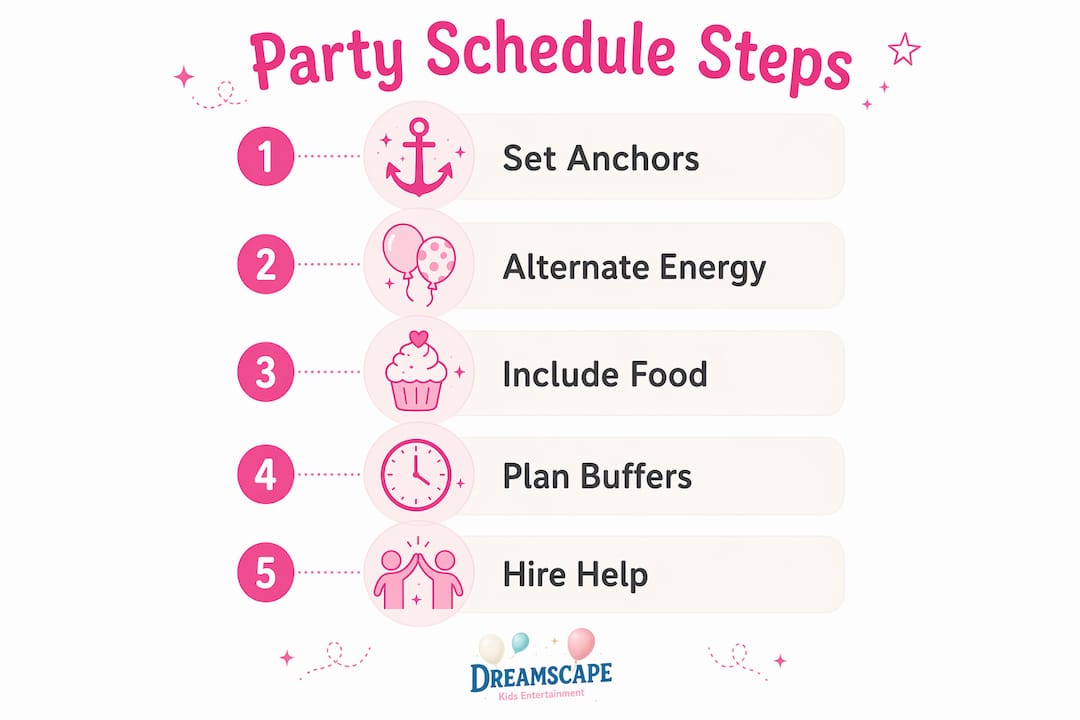
Two ready-to-copy sample schedules:
90-minute schedule (toddlers and preschoolers, ages 2-5)
- 0:00 - Arrival and free play (colouring pages, bubbles, sticker station) - 15 min
- 0:15 - Welcome and warm-up game (musical statues, simple parachute) - 10 min
- 0:25 - Main headline activity (entertainer, princess visit, superhero game) - 20 min
- 0:45 - Food and birthday cake - 20 min
- 1:05 - Wind-down craft or quiet activity - 10 min
- 1:15 - Party bags and goodbyes - 15 min
2-hour schedule (school-age, ages 6-10)
- 0:00 - Arrival and free play - 15 min
- 0:15 - Warm-up game (relay race, freeze dance) - 15 min
- 0:30 - Main headline activity (entertainer, scavenger hunt, themed challenge) - 30 min
- 1:00 - Food - 20 min
- 1:20 - Second activity (craft, group game) - 15 min
- 1:35 - Cake and singing - 10 min
- 1:45 - Party bags and pickup - 15 min
Lock these in before anything else:
- Start time and end time
- Main headline activity (your “wow” moment)
- Food and cake timing
- Number of guests and adult helpers
Dreamscape Kids Entertainment, Melbourne’s family-run party specialists with over 1,900 five-star reviews and all entertainers holding Working With Children Checks, can run your headline activity block so you focus on the rest.
Table of Contents
- How do you choose a theme and narrow your activity list?
- What are the core rules for layering party activities?
- How long should the party and each activity be, by age?
- Ready-to-use sample schedules for themed parties
- What logistics does each activity actually need?
- Where does food fit in the timeline?
- When does hiring a professional entertainer actually help?
- Key takeaways
- The part most hosts get wrong
- Dreamscape can run the hard part for you
- Useful sources and further reading
- FAQ
How do you choose a theme and narrow your activity list?
Start with what genuinely excites the birthday child, then match theme complexity to age. A five-year-old who loves fairies doesn’t need seven fairy-themed stations. They need one magical moment and a few supporting touches.
Once you have the theme, list every activity idea you can think of. Then cut ruthlessly using this filter:
- High impact, low effort: keep these (a single entertainer, a themed treasure hunt)
- High impact, high effort: keep one maximum (your headline “wow”)
- Low impact, low effort: use as arrival or wind-down fillers only
- Low impact, high effort: cut entirely
The goal is one headline activity, one supporting activity, and 1-2 arrival or wind-down options. That’s your whole schedule. Anything beyond that risks setup chaos and a host who’s too stressed to enjoy the party.
When decor, food, and activities share the same theme, each element reinforces the others without extra cost. A pirate party’s “treasure chest” centrepiece doubles as the prize box for the scavenger hunt. Fairy bread cut into star shapes fits a space theme. These overlaps save money and reduce the number of separate things you need to manage.
Pro Tip: Budget your time and money toward one headline “wow” element rather than spreading thin across many small extras. A single themed entertainer or interactive station is more memorable than six mediocre activities.
What are the core rules for layering party activities?
The golden rule: never run two high-energy activities back to back, and never let a low-energy block drag long enough that kids get bored and restless. Alternate the energy, and the party runs itself.
Energy bands and examples:
- High energy: relay races, obstacle courses, dance parties, superhero challenges, bounce activities
- Medium energy: scavenger hunts, group games, musical chairs, freeze dance
- Low energy: colouring stations, craft tables, storytime, sticker activities, food
A three-stage flow works reliably for most parties: arrival and warm-up (low to medium), mid-party peak (high energy headline activity), then wind-down (low energy, food, cake). Place your main event before food, not after. Kids are focused and energetic before eating; they’re slow and distracted after.
Transitions are where schedules fall apart. Music is one of the simplest tools: a well-timed playlist signals a shift in energy without you needing to shout over 15 kids. Crank it up for active blocks, drop it low for craft time.
Statistic callout: Kids’ attention spans average just 15-20 minutes per activity, which is why pacing and variety are the most important scheduling decisions you’ll make.
Pro Tip: Read the room. If a high-energy game is going brilliantly at the 15-minute mark, let it run another five minutes and trim the next low-engagement block. Flexibility beats a rigid clock every time.

How long should the party and each activity be, by age?
Total party length matters as much as what’s in the schedule. Too long and toddlers melt down; too short and school-age kids feel cheated.
| Age group | Total party length | Per-activity timing | Notes |
|---|---|---|---|
| Toddlers (1-3) | 60-90 minutes | 10-15 min | Food earlier; nap schedules matter |
| Preschoolers (3-5) | 90-120 minutes | 15-20 min | Arrival free play is essential |
| School-age (6-10) | - | 20-30 min | Can handle 2-3 structured activities |
Mixed-age groups are trickier. Default to the youngest guests’ stamina and schedule food earlier than you think you need to. Very young children need to eat before they hit the wall, not after.
Transition and buffer rules:
- Allow 5-10 minutes between every activity for setup, pack-up, and toilet breaks
- Place cake 20-30 minutes before the end so it acts as a natural closing cue
- Never schedule more than two structured activities before a food break
- Build a 10-minute “float” into the back half of the schedule for anything that runs over
Ready-to-use sample schedules for themed parties
These templates are designed to be copied straight into a printed run sheet. Swap the activity names to match your theme.
Template 1: 90-minute toddler party (ages 2-4, princess / fairy / animal theme)
- 0:00 - Arrival station (stickers, colouring, bubbles) - 15 min. Setup: pre-laid table, no staff needed.
- 0:15 - Welcome circle and warm-up song - 5 min. Host-led.
- 0:20 - Headline activity (character visit or themed entertainer) - 20 min. Entertainer manages this block.
- 0:40 - Food (finger foods, birthday cake) - 20 min. Pre-plated where possible.
- 1:00 - Wind-down craft (crown-making, wand decorating) - 15 min. Pre-cut materials on tables.
- 1:15 - Party bags and goodbye - 15 min.
Template 2: 2-hour school-age party (ages 6-9, superhero / pirate / sci-fi theme)
- 0:00 - Arrival and free play - 15 min.
- 0:15 - Warm-up relay or freeze dance - 15 min.
- 0:30 - Headline activity (scavenger hunt, themed challenge, entertainer) - 30 min.
- 1:00 - Food - 20 min.
- 1:20 - Second activity (craft, group game, trivia) - 15 min.
- 1:35 - Cake and singing - 10 min.
- 1:45 - Party bags and pickup - 15 min.
Template 3: Loose 2-hour flow (mixed ages or adult-supervised free play)
- 0:00 - Open arrival, activity stations running - 20 min.
- 0:20 - One structured group game - 20 min.
- 0:40 - Food - 25 min.
- 1:05 - Free play or second station - 20 min.
- 1:25 - Cake - 10 min.
- 1:35 - Wind-down, party bags - 25 min.
Quick theme swaps:
- Pirate: swap scavenger hunt clues for a treasure map, use a chest as the prize box
- Fairy/princess: replace relay with a “spell-casting” dance circle, add wand craft
- Sci-fi/space: obstacle course becomes a “mission training” circuit, craft is rocket-building
- K-Pop/pop star: warm-up becomes a dance tutorial, headline is a mini performance or lip-sync battle
What logistics does each activity actually need?
Every item on your run sheet needs four estimates before the party: setup time, run time, pack-up time, and the adult-to-child ratio required. Miss one and the schedule slips.
Per-activity logistics checklist:
- Materials ready and pre-staged the night before
- Setup time added to the schedule before the activity starts (not during)
- Pack-up time allocated after (even 3 minutes matters)
- One adult assigned per activity station
- Contingency: what happens if this activity runs short or long?
Safety is non-negotiable. Run a quick venue check before guests arrive: no trip hazards, sharp edges covered, outdoor areas fenced if toddlers are present. Any professional entertainer you hire should hold a current Working With Children Check. Dreamscape’s entire team carries these, and it’s worth asking any external supplier the same question before you confirm a booking.
When to hire a helper versus a professional entertainer: if your headline activity requires audience management, precise timing, or specialist equipment (a character costume, a magic show, a dance performance), a professional is worth the cost. For simpler stations like a craft table or a pass-the-parcel, a trusted parent helper is fine. Brief any helper or entertainer on your run sheet at least a week out, and confirm timings the day before.
For supplier bookings like entertainers, cakes, and equipment hire, lock them in early. Popular Melbourne entertainers book out weeks ahead, especially on weekend afternoons.
Where does food fit in the timeline?
Food is your schedule’s anchor. Serve it after a major high-energy block and kids arrive at the table ready to sit. Serve it too early and you lose the momentum of the party; too late and you have hungry, cranky guests who can’t focus on anything.
Low-effort food ideas that double as theme moments:
- Fairy bread cut into theme shapes (stars, hearts, shields)
- Themed cupcakes at each place setting (no cutting, no waiting)
- A slush machine or interactive drink station as a wow moment between activities
- Finger foods that kids can grab without sitting down, for loose-flow parties
The “one wow factor” rule applies to food too. One spectacular cake or one interactive food station beats a spread of mediocre options. It’s also far easier to execute under pressure.
Cake placement belongs 20-30 minutes before the end of the party. It signals to guests that the event is wrapping up, which makes departure smoother and reduces the awkward “is it over?” limbo.
Pro Tip: Ask about allergies on the RSVP and choose finger foods that are easy to serve quickly. Avoid high-sugar items right before pickup - a sugar spike at 4:30pm is the parents’ problem, and they’ll remember it.
When does hiring a professional entertainer actually help?
Hire a professional when your headline activity needs someone to own the room. Managing 15 excited six-year-olds through a themed challenge while keeping the energy high and the timing tight is a specific skill. It’s not something a stressed host can do while also watching the food and greeting late arrivals.
Dreamscape entertainers run the main activity block, manage transitions, and keep the energy calibrated so the rest of the schedule holds. That frees the host to handle food, parents, and the hundred small things that come up on the day.
When a professional entertainer makes sense:
- Your headline activity requires a character costume or specialist performance
- Guest count is above 12 children
- You’re hosting without a co-host or second adult
- The venue is large or has multiple zones to manage
Pro Tip: Brief your entertainer on the full run sheet, not just their slot. A good entertainer will incorporate your theme into transitions and warm-up moments, not just the headline block - which tightens the whole schedule.
Dreamscape has delivered themed children’s entertainment in Melbourne for over 25 years, with more than 1,900 five-star reviews and a team that holds Working With Children Checks. For a sense of what a themed block looks like in practice, their Blippi-style entertainer page shows how a character-led session runs from arrival to wrap-up. Pricing details are listed transparently on their packages page if you’re weighing a professional against a DIY approach.
Key takeaways
A layered themed party schedule works when you alternate energy, anchor with food, and protect every transition with a buffer.
| Point | Details |
|---|---|
| Alternate energy blocks | Never run two high-energy activities back to back; follow every peak with a quieter block. |
| Anchor with food | Serve food after the main high-energy activity so guests are ready to sit and settle. |
| One wow factor | Invest in one headline activity or entertainer rather than spreading budget across many small extras. |
| Build in buffers | Add 5-10 minutes between every activity for setup, pack-up, and toilet breaks. |
| Dreamscape for headline blocks | Dreamscape’s Melbourne entertainers run the main activity block and manage transitions, backed by 25+ years’ experience and 1,900+ five-star reviews. |
The part most hosts get wrong
There’s a habit that separates a smooth party from a chaotic one, and it has nothing to do with decorations or how many activities you planned. It’s the willingness to let a running activity run.
Most hosts over-schedule because the blank spaces on a run sheet feel like failure. They’re not. A 10-minute buffer that you never need is invisible to guests. A frantic scramble to set up the next activity while kids are already bored and wandering is very visible.
The Dreamscape team has seen this play out hundreds of times. A dance game that was supposed to run 15 minutes is still going strong at 22 minutes because the kids are genuinely loving it. The right call is to let it breathe and quietly trim the craft activity that follows. The wrong call is to cut it off because the clock says so. Guests remember how the party felt, not whether it ran to the minute.
Build your schedule with that flexibility in mind. Write the run sheet, then identify which blocks are cuttable and which are fixed. Food and cake are fixed. The second craft activity is cuttable. Know that before the party starts, and you’ll handle every delay without panic.
Dreamscape can run the hard part for you
Planning the schedule is one thing. Executing the headline activity in front of 20 excited kids while keeping the energy right and the timing tight is another. That’s exactly where Dreamscape’s Melbourne entertainers earn their place.
Dreamscape has spent over 25 years delivering themed party entertainment across Melbourne, with characters ranging from princesses and superheroes to K-Pop performers. Every entertainer holds a Working With Children Check, and the team’s 1,900+ five-star reviews reflect a consistent track record with real Melbourne families. They run the headline block, manage the transitions around it, and hand the room back to you for food and cake without the chaos.
If you’re ready to hand off the hardest part of the day, check availability and packages at Dreamscape’s kids party entertainment page or view pricing and packages to compare options for your guest count and theme.
Useful sources and further reading
For deeper planning and Australian-relevant timing guidance, these resources are worth bookmarking:
- The ideal timeline for a smooth kids birthday party - age-based total lengths and transition buffer advice
- How to plan a party timeline - sample flows and cake-placement guidance
- Kids birthday party planning guide by age - three-stage energy structure with activity examples
- Easy kids birthday party tips - Australian-relevant advice on food timing and keeping it simple
- Kids party activity checklist - pacing, variety, and safety essentials
- Dreamscape blog: choosing the right party theme - matching theme complexity to age group
- Dreamscape blog: what actually happens during a 90-minute kids’ party - a practical walkthrough of a compact timeline
- Dreamscape blog: stress-free birthday party tips - buffer recommendations and day-of survival kit ideas
Before finalising your run sheet, confirm age-based timing with the guides above and check that any external supplier holds a current Working With Children Check.
FAQ
How do you organise a themed party schedule?
Start with your fixed anchors (start time, main activity, food, cake, end time), then fill the gaps with arrival and wind-down activities. Alternate high-energy and low-energy blocks and add 5-10 minute buffers between each transition.
How long should each activity be at a kids’ party?
Toddlers need activities of 10-15 minutes; preschoolers can manage 15-20 minutes; school-age children can sustain 20-30 minutes per structured activity. Keep total party length to 60-90 minutes for toddlers and 90-120 minutes for preschoolers.
What activities work well at a themed party?
Mix one high-energy headline activity (relay race, entertainer, scavenger hunt) with a medium-energy group game and a calm arrival or wind-down option like a craft station or colouring table. Dreamscape’s themed entertainers can run the headline block for you, covering everything from princess visits to superhero challenges.
What should you do when the schedule runs late?
Identify your cuttable blocks before the party starts - usually the second craft or a free-play buffer - and trim those first. Food and cake timing should stay fixed; everything else can flex.
Recommended
Planning a Melbourne party?
We will get right back to you.