

Dive into fun with these 10 delightful pirate party games for kids. Easy to set up, they guarantee laughter and excitement at any celebration!
Pirate party games kids will love: 10 easy ideas
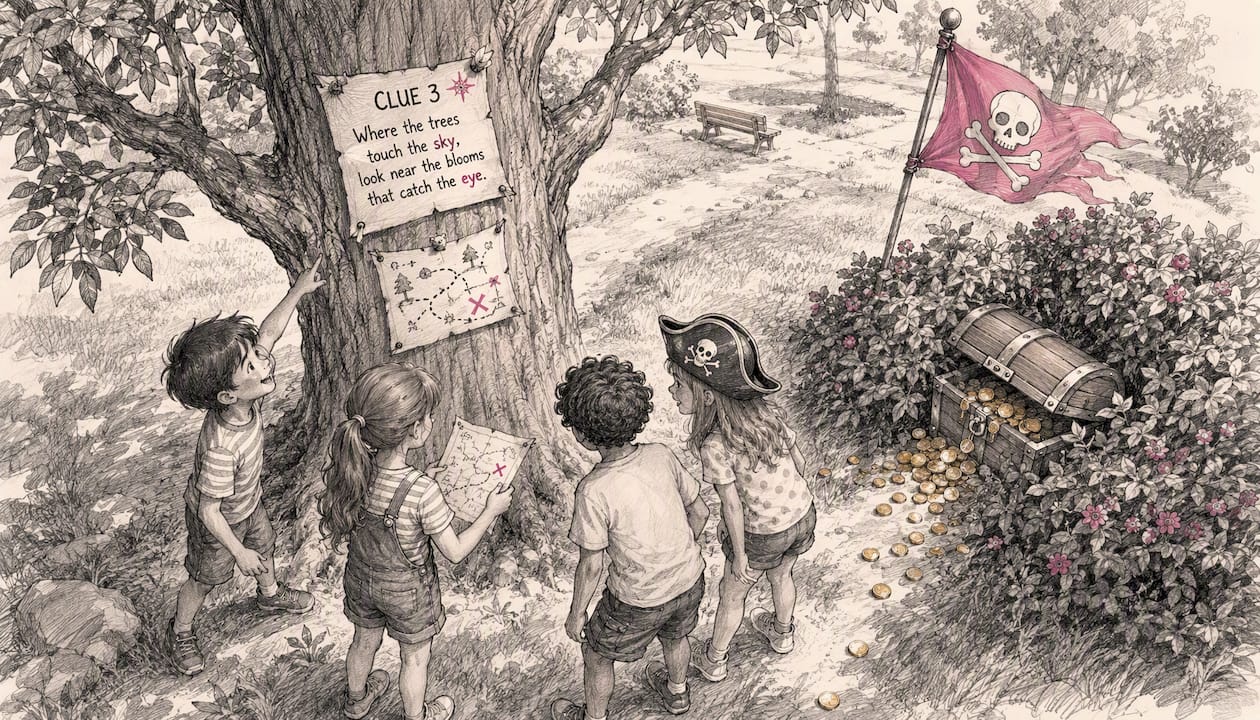
The best pirate party games for kids aged 3-10 are a treasure hunt, walk the plank, pirate ship relay, cannonball toss, pin the patch on the pirate, pirate bingo, a piñata bash, and ship-building craft. Each one runs with minimal gear, adapts easily for different ages, and keeps a moderate-sized group of kids genuinely entertained.
Quick age guide:
- Treasure hunt (4-10, all group sizes) - the anchor activity; high engagement, low cost
- Walk the plank (4-9) - active, needs one plank or taped line; 2 minutes to set up
- Pirate ship relay (5-10) - burns energy fast; great for groups of 10 or more
- Cannonball toss (3-8) - bean bags or socks into a bucket; calm enough for toddlers
- Pin the patch on the pirate (3-7) - classic blindfold game; zero running, easy indoors
- Pirate bingo (4-8) - quiet, printable, perfect alongside food
- Piñata bash (5-10) - crowd-pleaser; needs outdoor space or a high ceiling
- Ship-building craft (3-9) - calm-down activity; cardboard boxes, tape, foil
Grab these three things before anything else: a roll of masking tape (plank line, relay markers, bingo card holders), a bag of chocolate coins (prizes and treasure hunt loot), and a printer for bingo cards and treasure hunt clues.
Key takeaways
A sequential treasure hunt run in teams of 3-4 is the single highest-impact pirate party game for children aged 4-10, and pairing it with two active games and one calm craft covers every energy level in the group.
| Point | Details |
|---|---|
| Choose three core games | A treasure hunt, one active relay, and one calm activity covers all energy levels and age groups. |
| Prep the treasure hunt first | Write 6-8 sequential clues matched to your venue; picture clues for under-5s, riddles for 7-10 year olds. |
| Mix energy levels deliberately | Alternate active and calm games to keep the group fresh and reduce meltdowns in the final 30 minutes. |
| Check venue and safety before invites go out | Confirm council permits, shade, supervision ratios, and WWCC for any hired entertainer before the party date. |
| Dreamscape for stress-free delivery | Dreamscape’s pirate entertainers run the full game programme in Melbourne, with WWCC and insurance included. |
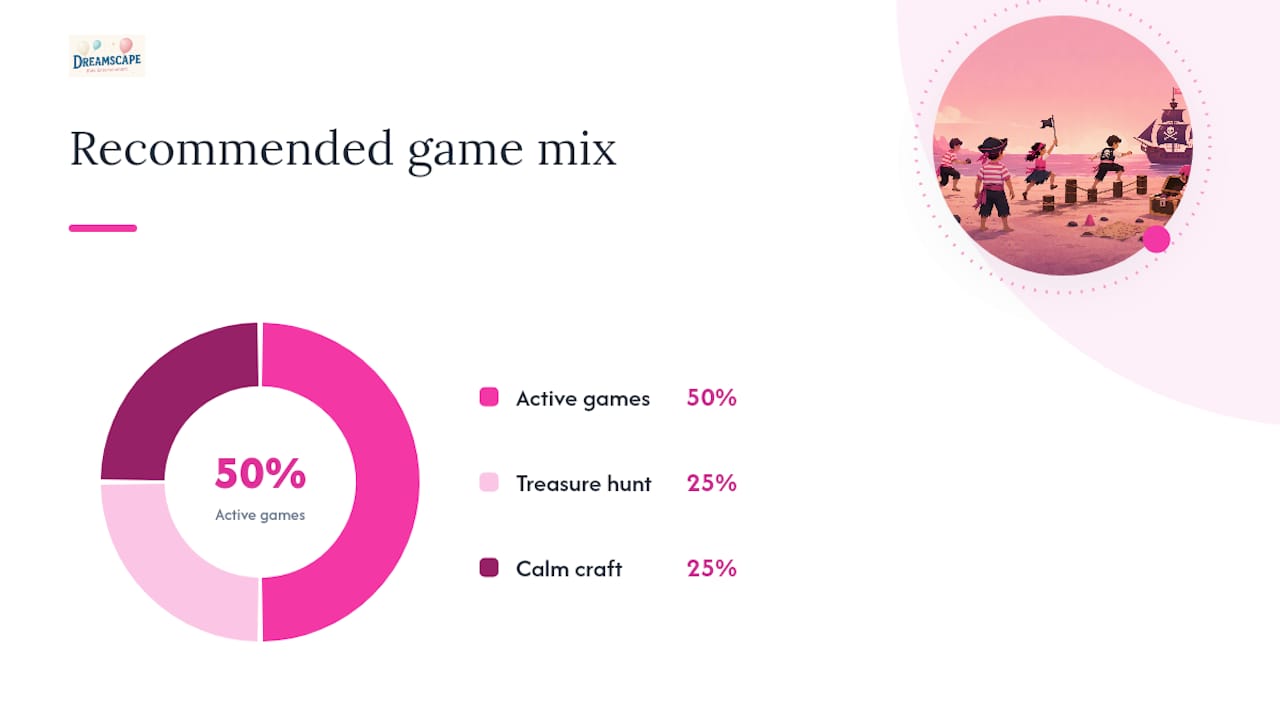
Table of Contents
- Best pirate party games: detailed setups and age variations
- How to run a pirate treasure hunt from scratch
- Quiet crafts and calm activities for mixed-age groups
- Sample party timelines that actually work
- Setup checklist and Australian safety tips for park parties
- When does hiring a professional entertainer make sense?
- Dreamscape makes pirate parties genuinely stress-free
- The part most pirate party guides get wrong
- Sources
- FAQ
Best pirate party games: detailed setups and age variations
Classic pirate games like walk the plank, treasure hunts, and pirate ship relays translate well across ages and need almost no budget. Here is how to run each one properly.
1. Treasure hunt
Ages: 4-10 | Setup: 20 minutes | Play time: 20-30 minutes
What you need: 6-10 printed or handwritten clues, a “treasure chest” (decorated box or bag), chocolate coins, small prizes.
Hide clues in sequence around the venue. Each clue leads to the next hiding spot. The final clue leads to the treasure. For under-5s, use picture clues or simple rhymes. For 7-10 year olds, riddles work well. Run it as teams of 3-4 for groups over 12.
Variation: Indoors, use rooms and furniture as landmarks. Outdoors, use trees, the sandpit, or the BBQ area.
2. Walk the plank
Ages: 4-9 | Setup: 5 minutes | Play time: 10-15 minutes
What you need: A plank of wood (smooth, 15-20 cm wide, 1.5-2 m long) or a strip of masking tape on the ground. Optional: a blue sheet underneath as “shark water.”
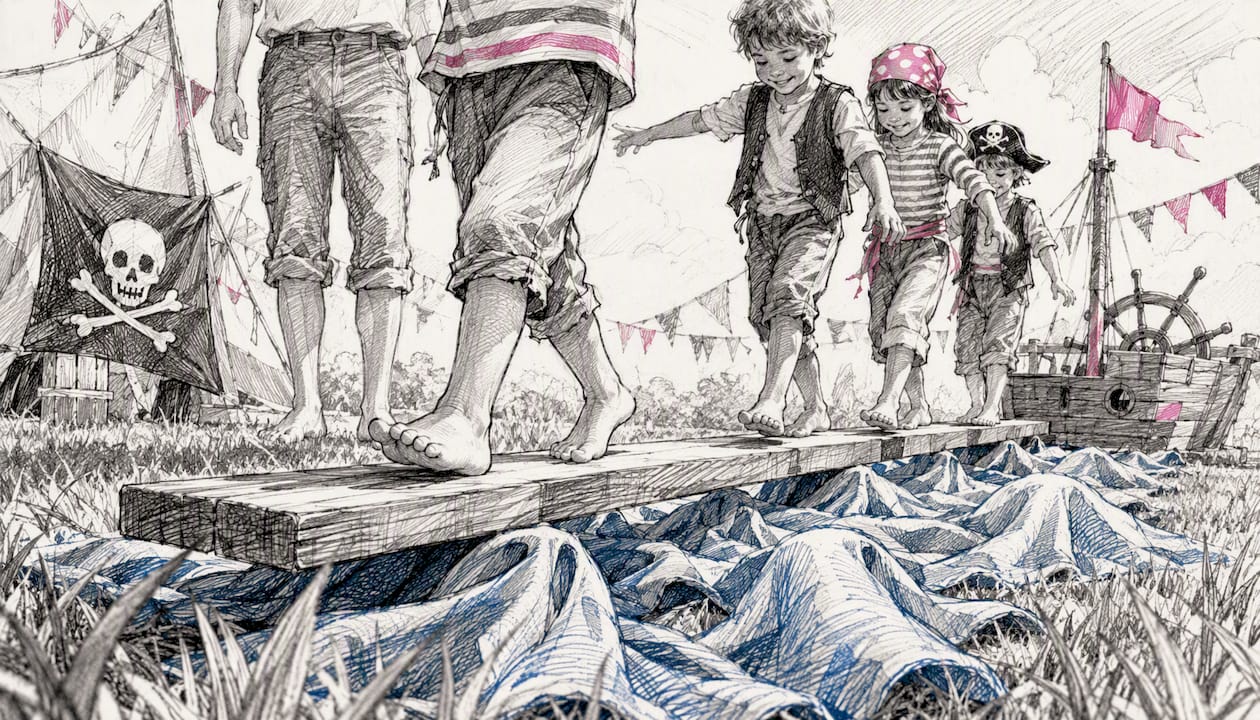
Kids take turns walking the plank while the group chants. Anyone who wobbles off “falls to the sharks” and sits out until the next round. For younger kids, use the tape-on-floor version only - no raised plank.
Safety note: Keep any raised plank no more than 10 cm off the ground and place crash mats or thick grass underneath. An adult spots each child.
Variation: Add a blindfold for 7+ year olds to increase the challenge.
3. Pirate ship relay
Ages: 5-10 | Setup: 5 minutes | Play time: 10-15 minutes
What you need: Two hula hoops or chalk circles (the “ships”), bean bags or soft balls (the “cargo”), cones or tape for the relay course.
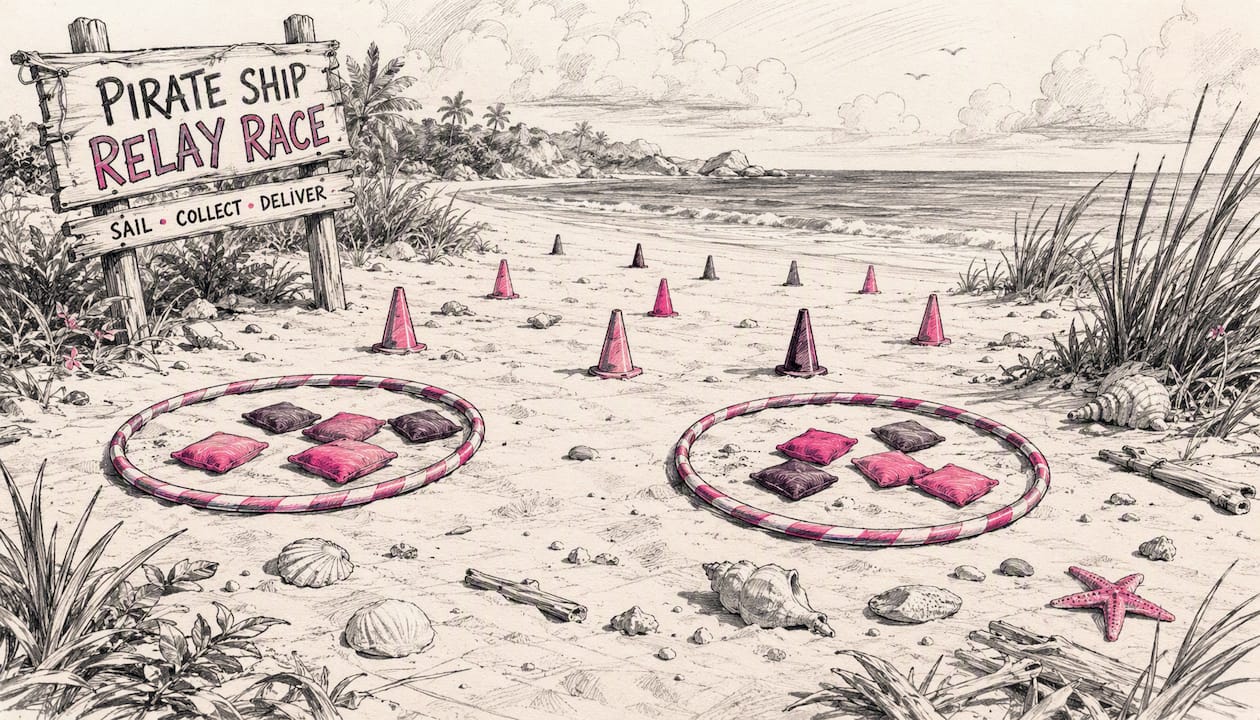
Split kids into two teams. Each player runs from the ship, grabs a piece of cargo from a central pile, and runs back. First team to load their ship wins. Works brilliantly outdoors on grass.
Variation: For mixed ages, give younger kids a shorter run distance. Indoors, use a hallway or cleared lounge room.
4. Cannonball toss
Ages: 3-8 | Setup: 2 minutes | Play time: 10 minutes
What you need: A bucket or decorated box, rolled-up socks or small bean bags (“cannonballs”).
Mark a throwing line with tape. Kids toss cannonballs into the bucket from increasing distances. Give three throws each. Works indoors or out, and toddlers can stand right next to the bucket.
Variation: Use multiple buckets at different distances and assign point values.
5. Pin the patch on the pirate
Ages: 3-7 | Setup: 5 minutes | Play time: 10 minutes
What you need: A large printed or hand-drawn pirate face poster, cut-out eye patches with sticky tack, a blindfold.
Classic pin-the-tail format. Spin each child gently, point them at the poster, and let them stick their patch. Closest to the eye wins. Entirely indoor-friendly and calm enough to run during food time.
6. Pirate bingo
Ages: 4-8 | Setup: 10 minutes (print cards ahead) | Play time: 15 minutes
What you need: Printed bingo cards with pirate images (treasure chest, parrot, skull, anchor, ship), calling cards, small prizes.
Pro Tip: Twinkl’s free pirate game printables include ready-made bingo cards and calling sets - print them the night before and you’re done.
Caller draws a card and names the image. First to complete a row wins. Run multiple rounds with small prizes each time so more kids win.
7. Pirate piñata
Ages: 5-10 | Setup: 30-60 minutes (DIY) or buy ready-made | Play time: 10-15 minutes
What you need: A piñata (shop-bought or papier-mâché), a stick or bat, a blindfold, lollies and small toys to fill it.
Hang the piñata from a tree branch or outdoor frame. Each child gets 2-3 swings, blindfolded. When it breaks, everyone scrambles for the loot. Give younger kids a shorter stick and a lower hang.
When making a DIY piñata, watch your layer count: too many layers and the game drags on, too few and it collapses on the first hit. Three to four papier-mâché layers is the sweet spot for a 20-minute game.
Safety: Keep non-swinging kids at least 2 metres back. One adult controls the swing rotation.
8. Peg-leg race
Ages: 5-9 | Setup: 2 minutes | Play time: 10 minutes
What you need: Tape or chalk start and finish lines, optional pool noodles as “peg legs.”
Kids hop on one leg from start to finish. First one there wins. For a team version, make it a relay. Simple, burns energy, needs nothing.
9. Digging for gold
Ages: 3-6 | Setup: 10 minutes | Play time: 10-15 minutes
What you need: A sandpit or large tub of kinetic sand, buried chocolate coins or plastic gems.
Bury the coins before the party. Kids dig with their hands or small spades to find treasure. They keep what they find. Calm, tactile, and perfect for the youngest guests while older kids do relays.
10. Sleeping crocodiles (pirate edition)
Ages: 3-7 | Setup: 0 minutes | Play time: 5-10 minutes
What you need: Nothing.
One child is the “pirate captain.” Everyone else is a crocodile and must lie completely still on the ground. The captain walks around and tries to make them move or laugh without touching them. Anyone who moves becomes the next captain. Brilliant for winding kids down between active games.
How to run a pirate treasure hunt from scratch
The fastest effective treasure hunt format for 4-10 year olds is a sequential clue chain with 6-8 stops, run in teams of 3-4. It keeps every child moving, prevents one fast kid from dominating, and wraps up in under 30 minutes.
Build it in five steps
- Choose 6-8 hiding spots that are safe, accessible, and spread across the venue. Indoors: fridge, bookshelf, under a chair, bathroom mirror. Outdoors: a tree, the letterbox, the BBQ, a garden pot.
- Write one clue per spot. The clue at spot 1 leads to spot 2, and so on. The final clue leads to the treasure chest.
- Match clue type to age. For 3-5 year olds, use picture clues (a drawing of the fridge). For 5-7 year olds, use simple rhymes. For 7-10 year olds, use riddles.
- Divide into teams and give each team a different coloured clue set so they don’t follow each other. Teams of 3-4 work best; assign one adult helper per team for under-5s.
- Set up the treasure chest with enough loot for every child: chocolate coins, small toys, temporary tattoos, or pirate stickers.
Six sample clues (ready to use)
- “I keep things cold and food inside. Open my door - your next clue hides.” (Fridge)
- “Pirates wash their hands, it’s true. Find your clue where water comes through.” (Bathroom tap)
- “I stand tall and give you shade. Under my branches, a clue was laid.” (Tree)
- “You sit on me when you want to eat. Look underneath - there’s a clue at your feet.” (Dining table)
- “I hold the letters that come each day. Your next clue is not far away.” (Letterbox)
- “The treasure is near - you’ve done so well! Dig in the chest and hear it jingle and yell.” (Final clue, treasure chest)
Team vs individual format
- Teams suit groups of 10 or more, mixed ages, and outdoor spaces. They reduce competition pressure and let older kids help younger ones.
- Individual hunts work for small groups of 4-6 same-age kids who are competitive and can read independently.
For mixed-age groups, stagger clue difficulty or assign adult helpers per team so younger children stay engaged rather than frustrated.
Prize tip: Give every child a small prize at the end regardless of finishing order. Hand out “crew medals” (gold stickers) to all participants, then a slightly bigger prize to the winning team.
Quiet crafts and calm activities for mixed-age groups
The single best calm activity to run alongside active games is ship building with cardboard boxes. Set it up in a corner before guests arrive, and kids can drift in and out between relay rounds without disrupting the flow.
Here are five more options, each with a one-line age tweak:
- Pirate colouring sheets - print pirate scenes from free sites or Twinkl; for toddlers, use thick-line outlines and chunky crayons.
- DIY eye patches - pre-cut felt patches, elastic, and fabric markers; toddlers decorate with stickers, school-age kids draw their own designs.
- Treasure map drawing - blank paper, brown tea-stained edges (prep the night before), gold and black markers; older kids love adding landmarks and an “X.”
- Pirate hat folding - newspaper pirate hats are a 3-minute fold; YouTube has clear tutorials; works for ages 5 and up with adult help.
- Decorate a treasure chest - small cardboard boxes, gold paint, stickers, and gems; kids take their chest home filled with their prizes.
Staffing the craft area: One adult helper can manage 6-8 kids at a craft table. Set out all materials before the party starts so the helper isn’t scrambling. For a larger group, ask one older sibling or teenage helper to run the station.
Toddler swap: Replace scissors with tear-and-stick activities. Replace small gems with large foam stickers to avoid choking hazards.
Sample party timelines that actually work
90-minute party
- 0-15 min - Arrival and free play; craft station open (ship building or colouring)
- 15-30 min - Welcome game: cannonball toss or pin the patch (low-energy warm-up)
- 30-50 min - Treasure hunt (main event)
- 50-60 min - Food and drinks
- 60-75 min - Pirate bingo or sleeping crocodiles (calm, seated)
- 75-85 min - Cake and singing
- 85-90 min - Lolly bags and farewells
2-hour party
- 0-15 min - Arrival; craft station open
- 15-30 min - Warm-up game: cannonball toss or peg-leg race
- 30-55 min - Treasure hunt
- 55-70 min - Food and drinks
- 70-85 min - Pirate ship relay or piñata (high energy, post-food gap of 15 minutes)
- 85-100 min - Cake and singing
- 100-115 min - Pirate bingo or craft wrap-up
- 115-120 min - Lolly bags and farewells
Pro Tip: Place the treasure hunt before food, not after. Kids are sharpest and most energetic in the first 40 minutes. Post-food relays are fine, but a post-food treasure hunt with clue-reading is harder to manage.
Handling early arrivals: Keep the craft station running from the moment the first guest walks in. It gives early arrivals something to do without waiting awkwardly, and it means latecomers don’t miss a game.
Split-age groups: If you have a wide age spread (say, 3-year-olds and 9-year-olds), run the treasure hunt in mixed-age teams so older kids guide younger ones. Keep the piñata and relay for the older group while younger kids do digging for gold simultaneously.
Weather delays: For outdoor parties, have a backup indoor game list ready. Sleeping crocodiles, pirate bingo, and pin the patch all move indoors in under two minutes. For planning a Melbourne park party, check the Bureau of Meteorology forecast the morning of the event and have a wet-weather plan confirmed the night before.
Setup checklist and Australian safety tips for park parties
The most important safety step is confirming your supervision ratio and venue suitability before you send a single invitation.
Pre-party checklist
| Item | What to check |
|---|---|
| Venue visit | Visit the park a week before at the same time of day to assess parking, shade, playground access and likely crowds |
| Council permits | Check local council rules on gatherings, shelter bookings, marquees, generators and open flames - rules vary by council |
| Shade and water | Confirm shade structures or BYO gazebo; bring extra water and sunscreen (SPF 50+) |
| Toilets | Locate the nearest public toilets and check they are open |
| Sun safety | Hats and sunscreen for all children; schedule outdoor games before 10 AM or after 3 PM where possible |
| Small parts | Remove or bag any small game pieces (gems, coins) for children under 3 |
| Hired entertainers | Confirm Working With Children Check (WWCC) and public liability insurance before booking |
| Inflatables | Ensure inflatables are anchored and operated by a competent provider with adult supervision at all times |
| BBQ/open flame | Check council rules; keep children at least 2 metres from any heat source |
Game-specific safety notes
- Walk the plank: Raised plank no higher than 10 cm; adult spotter for every child; soft surface underneath.
- Piñata: Non-swinging children stand at least 2 metres back; one adult controls the rotation; check venue rules on hanging equipment.
- Water play: Designate a water area away from the main game zone; supervise at a 1:3 ratio for under-5s.
- Relay races: Clear the course of trip hazards before starting; no running on wet grass.
When does hiring a professional entertainer make sense?
Hire a professional if your guest list tops 15 kids, you have a wide age spread, or you simply want to enjoy the party rather than run it. A good entertainer manages the game flow, handles prize distribution, leads singalongs, and keeps the group together between activities - the things that quietly exhaust a DIY host.
What a professional pirate entertainer brings:
- Full game facilitation (treasure hunt, relays, bingo, piñata) with props and costumes included
- Group management and transition handling between activities
- A Working With Children Check and public liability insurance
- Experience reading a crowd - knowing when to switch from active to calm and back again
- Themed show elements like character storytelling, pirate songs, and interactive skits that a DIY host can’t easily replicate
Questions to ask when booking:
- Do you hold a current WWCC and public liability insurance?
- What is your maximum group size, and do you bring an extra helper for larger groups?
- What is included in the package (props, prizes, music)?
- Can you adapt games for a mixed-age group?
- What happens if the entertainer is unwell on the day?
Pro Tip: Ask for a run sheet before the party day. A professional entertainer should be able to give you a minute-by-minute plan so you know exactly what is happening and when.
For Melbourne families, Dreamscape’s pirate entertainer hire covers all of the above, with over 1,900 five-star reviews and every entertainer holding a current WWCC.
Dreamscape makes pirate parties genuinely stress-free
Planning ten games, printing clue sheets, sourcing prizes, managing 20 kids, and keeping an eye on the BBQ simultaneously is a lot. Dreamscape’s pirate party entertainers handle the games, the group, and the energy so you can actually be present at your child’s party.

Dreamscape has delivered children’s party entertainment across Melbourne for many years, with a roster of professional pirate characters who arrive in full costume, run the full game programme, and manage everything from the treasure hunt to the final lolly bag handout. Every entertainer holds a current Working With Children Check and public liability insurance. Packages are transparent on pricing, and the team scales from small backyard parties to large school events. If you are weighing up DIY versus hiring a pro, check availability and book a pirate entertainer directly through Dreamscape.
The part most pirate party guides get wrong
Most pirate party articles hand you a list of ten games and leave you to figure out the rest. The problem is not the games - it is the order and the pacing. Parents consistently underestimate how quickly a group of 15 kids burns through a game (usually 10-12 minutes, not the 20-30 the guide suggests), and they overestimate how long food will hold attention.
The conventional advice to “save the treasure hunt for last as a big finale” is genuinely bad. By the time you hit the 90-minute mark, younger kids are tired, older ones are restless, and the clue-reading that makes a treasure hunt work falls apart. Run it at the 20-30 minute mark, when energy is highest and focus is sharpest.
The other thing guides skip is the transition. Moving 15 kids from a relay race to a seated bingo game without a plan takes four minutes and costs you the group’s attention. The fix is simple: have the next activity already set up and visible before the current one ends. Kids will drift toward it naturally.
Finally, the “hire a professional” advice is usually buried at the bottom as an afterthought. For groups over 15 or parties with a wide age spread, a professional entertainer is not a luxury - it is the difference between running the party and being at the party. That distinction is worth thinking about before you commit to DIY.
Sources
- Top 10 tips for hosting a park party for kids | Bounty Parents
- How to Plan a Party at a Park in Australia - Giddee
- 7 International Talk Like a Pirate Day Party Ideas
- Pirate Game Ideas - Twinkl
FAQ
What are the best pirate party games for young kids?
Cannonball toss, digging for gold, and sleeping crocodiles are the strongest picks for under-5s - all require minimal reading, no running hazards, and zero waiting time. Pin the patch on the pirate works well indoors for the same age group.
How do you run a pirate treasure hunt for kids?
Write 6-8 sequential clues, each leading to the next hiding spot, with the final clue pointing to a decorated treasure chest. Use picture clues for children under 5 and riddles for ages 7 and up; run it in teams of 3-4 for groups over 10.
What food and drink suits a pirate-themed party?
Chocolate coins, “shark fin” sandwiches (triangles with a toothpick flag), fruit skewers labelled “mermaid wands,” and blue jelly cups as “ocean water” are easy crowd-pleasers. Keep drinks to water and juice in labelled “pirate grog” cups to manage sugar levels during active games.
How do you throw a pirate party on a tight budget?
A masking tape plank line, rolled-sock cannonballs, printed bingo cards from Twinkl, and chocolate coins from the supermarket cover four solid games for under $30. The treasure chest can be a decorated shoebox, and prizes can be stickers and temporary tattoos.
When should you hire a professional pirate entertainer?
Hire a professional when your guest list exceeds 15 children, you have a wide age range, or you want the games managed without your direct involvement. Dreamscape’s pirate party entertainers in Melbourne arrive in full costume with props, games, and a WWCC, and handle everything from the treasure hunt to the final farewell.
Recommended
Planning a Melbourne party?
We will get right back to you.