

Parents: learn how kids entertainer travel fees are calculated, see worked examples, and use a booking checklist to get clear, written travel quotes.
Budget $30-$120 for Kids Entertainer Travel Fees, Parents’ Booking Checklist

Yes, most kids entertainers charge travel fees once a booking sits outside their included radius, and you should budget for it upfront. Typical models range from free travel within 20-40 kilometres to per-kilometre rates around $1-$2, or flat bands like $20 per 10 kilometres. On a suburban booking that’s often nothing extra; on an outer-suburb or regional party, add $30 to $120 to your total.
TL;DR:
- Most kids entertainers charge extra travel fees for locations outside their included radius, typically $1-$2 per kilometre or flat rates like $20 per 10 km.
- Travel costs increase significantly for outer suburbs and regional bookings, often adding $30 to $120 depending on the distance and time of day.
- It is essential to clarify in writing whether the fee covers one-way or return trips and if parking or tolls are invoiced separately to avoid surprises.
- Travel fees are justified by costs such as fuel, vehicle wear, and the entertainer’s time, especially when they cannot book another job nearby.
- Booking processes that provide upfront, transparent quotes based on your exact address help prevent misunderstandings about travel-related charges.
Table of Contents
- Typical travel fee models and price ranges
- What factors push travel fees up or down?
- Sample calculations: turning policy into a real number
- Booking checklist: questions to ask before you confirm
- Why professional entertainers charge for travel at all
- Is travel time billed separately from the distance fee?
- When paying more for travel actually makes sense
- How Dreamscape quotes travel fees before you book
- Sources
- FAQ
Typical travel fee models and price ranges
Providers generally use one of three pricing structures, and knowing which one you’re dealing with makes comparing quotes much easier.
An included radius is the most common setup. The entertainer sets a free travel zone, often 20 to 40 kilometres from their base, and anything inside that circle costs nothing extra. Beyond it, most switch to a per-kilometre rate, typically $1 to $2 per kilometre once you cross the line. Others prefer flat distance bands, charging a set fee for each additional stretch beyond the free zone.
You’ll also want to check whether the fee covers a one-way trip or the return journey. A Melbourne-based entertainer’s terms might list a free moderate-distance radius, then charge a per-kilometre fee calculated on the return trip, which effectively doubles the distance used in the calculation compared to a one-way quote.
Common inclusions and exclusions to watch for:
- Free radius zones (usually 20 to 40 km from the entertainer’s base)
- Per-kilometre rates for anything beyond that zone (commonly $1-$2/km)
- Flat-band charges (e.g. $20 per 10 km increment)
- Parking fees or toll costs, frequently invoiced separately
- Return-trip distance sometimes used instead of one-way distance
None of this is standardised across the industry, so the only way to know for certain is to ask for the specific formula in writing.
What factors push travel fees up or down?
Distance is the obvious driver, but it’s rarely the only one. Travel time matters just as much as kilometres. An entertainer stuck in peak-hour traffic for 45 minutes to reach a party 15 kilometres away is losing more working time than one who drives 30 kilometres on a clear road. Outer-suburban and regional bookings tend to carry the biggest surcharges, commonly ranging from $30 to $120 depending on how far out the venue sits and what time of day the booking falls.
A few other things nudge the number:
- Paid parking or toll roads, which some providers invoice on top of the travel fee
- Extra set-up time needed for larger props, sound equipment or multiple stations
- Booking two or more entertainers, since travel costs are often charged per performer
- “Dead time” between bookings, where an entertainer can’t fit another job around yours because of the drive
Pro Tip: If your party falls between two other bookings on the entertainer’s schedule that day, ask if a multi-booking discount applies. Some providers reduce or waive the travel fee when they’re already heading in your direction.
Sample calculations: turning policy into a real number
The clearest way to understand travel fees is to see them worked out against an actual address. Here’s how three common scenarios play out.
- Inner suburb, within the free radius. Your party is 12 kilometres from the entertainer’s base, and their policy includes free travel up to 20 kilometres. Result: no travel fee at all, and the price you see on the package page is the price you pay.
- Outer suburb, beyond the free zone. The venue sits 35 kilometres away, with a 20 kilometre free radius and a $20 per 10 kilometre charge afterward. That’s 15 kilometres over the limit, rounded up to two 10 kilometre bands, adding $40 to your invoice.
- Regional booking with two entertainers. A princess and a superhero are both booked for a party 60 kilometres out, with a per-entertainer rate of $1.50/km on the return trip (120 km each). That’s $180 per entertainer, or $360 combined, plus any parking costs if the venue has none available on-site.
These numbers move depending on the provider, but the maths itself stays consistent: distance beyond the free zone, multiplied by the rate, multiplied by however many entertainers are travelling.
Booking checklist: questions to ask before you confirm
A vague verbal estimate is where most travel-fee disputes start. Before you pay a deposit, get the following answered in writing.
- How is the travel fee calculated. Ask for the exact formula. Per-kilometre, flat band, or a fixed regional surcharge.
- Whether the quote covers one-way or return-trip distance, since this can double the final figure.
- Whether parking, tolls or public transport costs sit inside the quote or get invoiced separately.
- What address was used to calculate the distance, and whether that matches your actual venue.
- What happens if the venue changes after booking, or if the event runs long and the entertainer has another job straight after.
- The cancellation and refund policy, particularly whether the travel fee is refundable if you cancel close to the date.
Watch for language like “travel may apply” or “POA” (price on application) with no further detail. It’s not necessarily a red flag on its own, but it should prompt a follow-up question rather than a guess. A provider that hesitates to put the formula in writing is worth a second look before you commit.
Why professional entertainers charge for travel at all
Travel fees aren’t padding; they also cover the party entertainment power needs such as fuel, vehicle wear, the entertainer’s time away from a job they could otherwise be doing closer to home, and the equipment they’re hauling, from sound systems to costume racks. They reflect real costs: fuel, vehicle wear, the entertainer’s time away from a job they could otherwise be doing closer to home, and the equipment they’re hauling, from sound systems to costume racks. Industry pricing guides point out that preparation, travel and performance time are all part of what a booking fee is built to cover, not just the hour spent entertaining the kids.
A performer who spends two hours driving to and from a regional party has effectively lost the chance to book a second party that afternoon. Charging for that time isn’t a markup. It’s the cost of being available.
Transparent pricing is one of the clearest signs a provider takes this seriously. Dreamscape publishes its package pricing rather than leaving parents to email and wait, and every entertainer on the roster holds a Working With Children Check, which matters just as much as the dollar figure when you’re letting a stranger into a birthday party.
Is travel time billed separately from the distance fee?
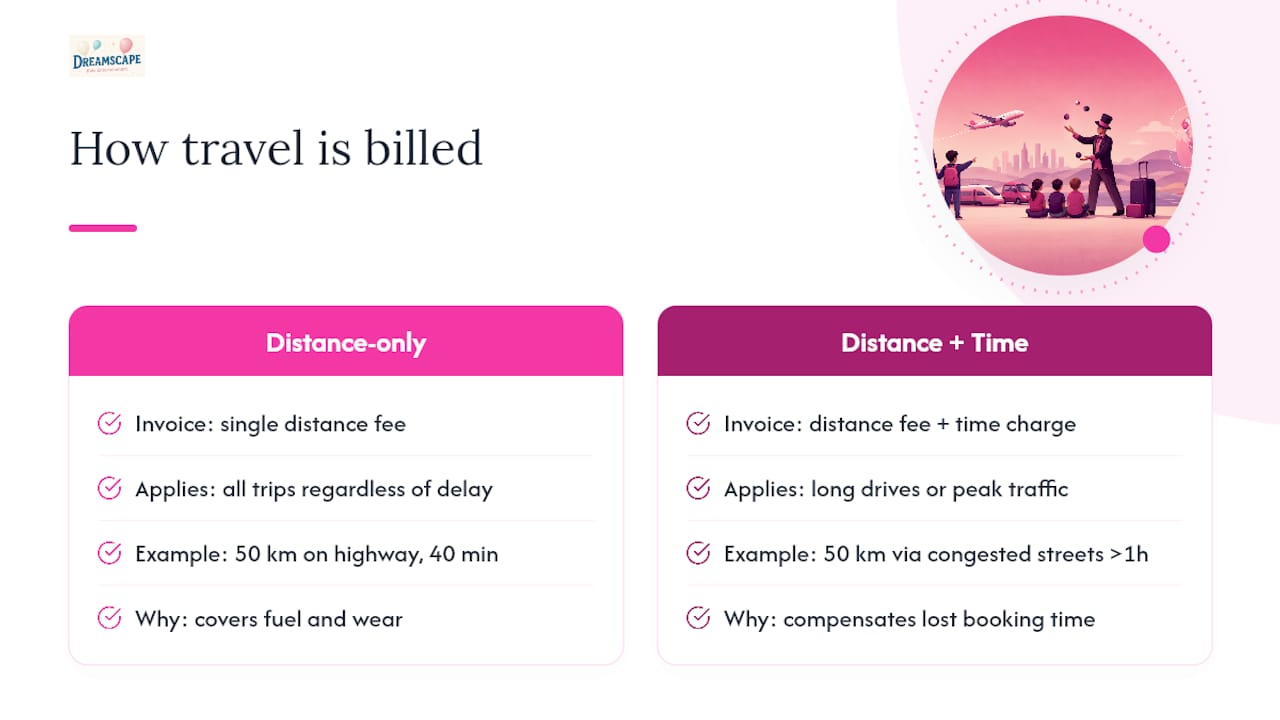
Sometimes, though it depends heavily on the provider. Some entertainers fold travel time into their distance-based fee entirely, so the per-kilometre or flat-band charge is the only travel cost you’ll see on the invoice. Others separate the two, charging a distance fee for fuel and wear on top of a time-based rate if the drive is unusually long or falls during peak traffic hours.
The distinction tends to show up most with regional bookings. A venue 50 kilometres away on a highway might take 40 minutes, while the same distance through congested suburban streets could take well over an hour. A handful of providers account for that difference by charging for the actual travel time involved rather than distance alone, particularly if a booking means they can’t fit another party into that time slot.
This is exactly why the booking checklist matters. If a quote lists a single travel fee, ask directly whether that figure already accounts for time on the road, or whether a separate time-based charge could still apply depending on traffic or the time of day. Getting this confirmed in writing before the deposit avoids the awkward surprise of a revised invoice showing up the week before the party.
When paying more for travel actually makes sense
Here’s my honest take: if your child has been talking about one specific character for weeks, that’s worth the extra travel cost. A specialist entertainer who nails the voice, the costume and the character interactions is memorable in a way a generic booking rarely is, and that’s the whole point of the party.

But if you’re booking a general entertainer, hire local. There’s no meaningful quality gap between a provider 10 kilometres away and one 50 kilometres away doing the same balloon-twisting-and-games format, so the travel fee buys you nothing except a bigger invoice.
If you want a clear quote either way, Dreamscape puts its travel policy in writing before you pay a deposit.
- Lauren
How Dreamscape quotes travel fees before you book
Dreamscape’s booking process is built to remove exactly the kind of guesswork this article has been talking about. You send an enquiry with your venue address, Dreamscape confirms the distance from their base, and you receive a written quote that separates the entertainment package from any travel component, so there’s nothing hidden between the price you see and the price you pay.

Every entertainer on the roster holds a current Working With Children Check, and the published pricing pages let you see package costs before you even make contact. Whether you need a princess for a backyard party in the inner suburbs or a full character lineup for a school event, the same transparent process applies. Melbourne families booking kiddie party entertainment can get an exact travel-inclusive quote by submitting their address upfront rather than waiting until after a deposit is paid. If it’s a school or corporate event you’re planning, the school entertainer booking page covers the logistics specific to those venues.
Sources
For readers who want to compare specific policy wording, these are worth a look:
FAQ
How much do children’s entertainers charge?
Base packages for a standard one to two hour booking commonly range from a few hundred dollars depending on the entertainer and inclusions, with travel fees added separately once you’re outside the free radius.
How much does an average kids party cost overall?
Total cost depends heavily on the number of guests, venue hire, catering and entertainment package chosen, but entertainment alone typically forms one line item among several, with travel as a smaller add-on rather than the main cost driver.
Is $500 a lot for a birthday party?
Not necessarily. A typical total spend includes venue hire, catering and a full entertainment package with multiple activities, especially once you factor in a modest travel fee for a suburban location.
Do all kids entertainers charge travel fees?
No. Many waive fees entirely within a set radius from their base, often 20 to 40 kilometres, and only charge once a booking falls outside that zone.
What should I ask before accepting a travel fee quote?
Ask exactly how the fee is calculated, whether it covers one-way or return distance, and whether parking or tolls are included, then get the answer in writing before paying a deposit.
Recommended
Planning a Melbourne party?
We will get right back to you.