

Discover how themed parties create lasting memories for kids by emphasizing emotional connections, active play, and fun experiences. Learn more!
How themed parties create lasting memories for kids

Themed parties create lasting memories when they prioritise emotional intensity, peer connection, and novel hands-on moments over decoration. Research consistently shows that children remember how they felt and what they did, not what the tablecloths looked like. Organisations like Play Australia confirm that imaginative, active play is the foundation of healthy development and long-term recall. Melbourne-based Dreamscape Kids Entertainment has built its entire service model around exactly these three memory drivers, which is why parties they run are still being talked about weeks later.
Table of Contents
- How themed parties create lasting memories: the science
- What professional entertainers do differently to make memories stick
- Age-by-age guide: what theme elements actually work
- Simple post-party actions that lock in the memory
- What to expect when hiring themed entertainers in Melbourne
- How to choose the right entertainer for your child
- Key takeaways
- What actually makes a party worth remembering
- Dreamscape brings the science of memory to Melbourne parties
- Useful sources
- FAQ
How themed parties create lasting memories: the science
Children’s brains encode memories most efficiently when an experience carries emotional weight, involves other people, and introduces something genuinely new. That triple combination triggers dopamine and serotonin responses that signal the brain to consolidate the experience for long-term storage. Sensory-rich, active play - think hands-on craft, movement, tactile discovery - is especially powerful because it engages multiple neural pathways at once, as the Sandplace research on birthday memory confirms.
Play Australia’s State of Play report adds that themed imaginative play supports social, emotional, and cognitive development simultaneously, giving children a safe space to practise empathy and problem-solving. That developmental overlap is why a well-run themed party does more than entertain - it gives children material to process and revisit.
The four evidence-based memory drivers to build a party around:
- Emotional intensity - surprise moments, character reveals, genuine delight
- Social connection - shared activities with friends, cooperative challenges
- Novelty and hands-on activity - first-time experiences, tactile stations, active participation
- Parent reminiscing - post-event conversation that consolidates what the child experienced
Stat to know: A landmark study on children who visited a memorable themed event found that children who talked about the experience more frequently with their families subsequently recalled significantly more detail during memory interviews - regardless of the child’s age.
Pro Tip: Start a five-minute “remember when” conversation the evening after the party. Ask open-ended questions: “What was the funniest part?” or “What surprised you most?” This simple routine, backed by APA reminiscing research, is one of the most effective memory-consolidation tools a parent has.
What professional entertainers do differently to make memories stick
Skilled entertainers don’t just perform - they design for moments of wonder and interactive participation. The difference between a party children forget by Monday and one they talk about for months usually comes down to a handful of deliberate design choices.
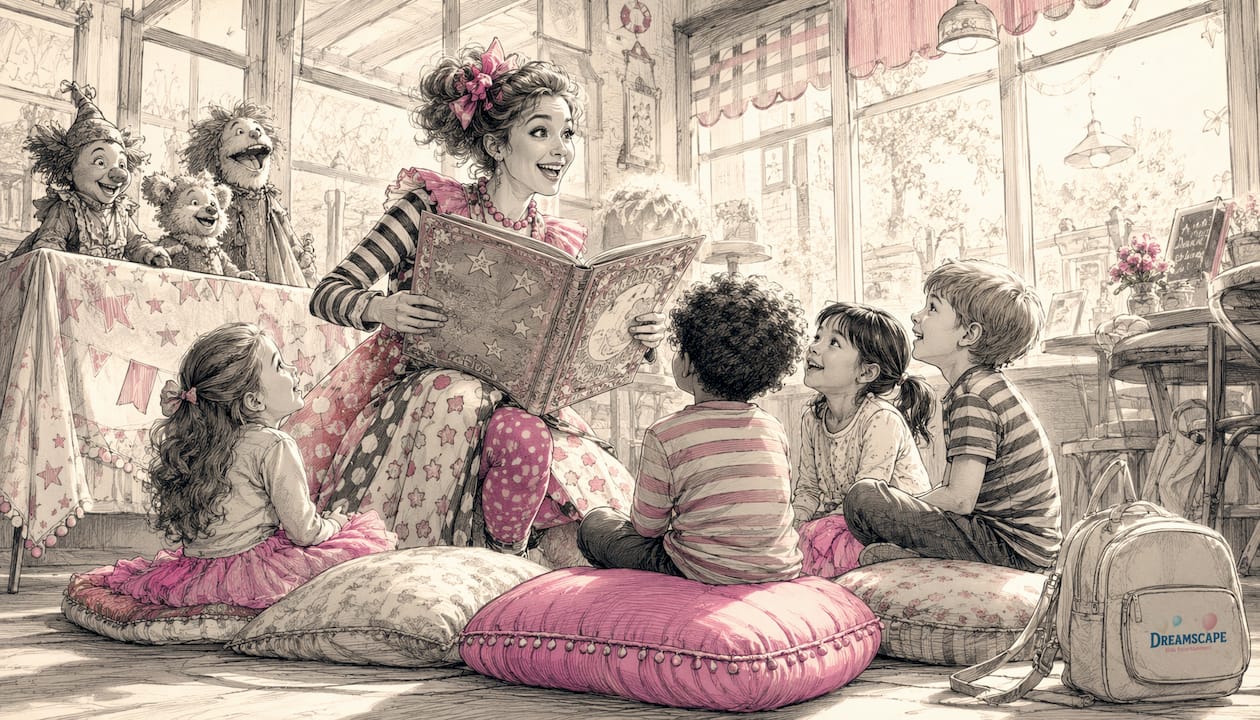
Professionals pace activities to create an emotional arc: a warm-up activity to settle nerves, a collaborative middle section that builds social bonds, and a climactic novelty moment (a character reveal, a hands-on discovery, a group mission completed) that lands with real emotional punch. They also build in adult-facing cues - small prompts that help parents capture the right photo or ask the right question later.
Trust signals to expect from any professional entertainer you consider:
- Valid Working With Children Check (WWCC) for every performer
- Public liability insurance, confirmed in writing
- Transparent inclusions list (what’s covered, what costs extra)
- Verifiable reviews and demonstrable years of experience
- Clear cancellation and wet-weather policy
Dreamscape’s entertainers hold WWCCs, carry public liability insurance, and have accumulated over 1,900 five-star reviews across 25+ years of Melbourne parties. That track record matters because experience directly shapes a performer’s ability to read a room and pivot when a group of six-year-olds goes sideways.
Pro Tip: When booking, ask the entertainer to describe their “novelty moment” - the single planned beat of genuine surprise. If they can’t name one, that’s a gap worth addressing before you sign anything.
Age-by-age guide: what theme elements actually work
Age matters more than most parents realise when planning a party. A format that thrills a nine-year-old can overwhelm a four-year-old, and vice versa.
| Age group | Best activity types | Attention span | Common pitfall |
|---|---|---|---|
| Toddlers (2-3) | Sensory play, simple dress-up, music and movement | 5-8 minutes per activity | Overstimulation from large groups or loud surprises |
| 3-5 years | Interactive storytelling, tactile craft, character role-play | 8-12 minutes | Too many transitions; passive watching |
| 6-8 years | Team challenges, cooperative missions, group games | 12 minutes | Activities that exclude shy children |
| 7 years and older | Peer-led challenges, creative problem-solving, social games | 20+ minutes | Themes that feel “babyish” to the group |
For 3-5-year-olds, interactive storytelling combined with a tactile craft station is the sweet spot. Children at this age are strongly engaged by imaginative play and character-led narratives, and a simple hands-on activity (decorating a wand, building a shield) gives them something physical to anchor the memory to.
From around age seven, peer collaboration becomes the priority. Children increasingly care about what their friends think, so activities that create shared achievement - a team completing a superhero mission, a group solving a mystery - carry far more emotional weight than individual performance. Keep guest numbers manageable: 8-12 children is a workable range for most structured activities, and a nanny daily schedule approach to pacing (alternating active and calm segments) prevents the energy crashes that derail the final hour.
Simple post-party actions that lock in the memory
Post-event conversation is a memory multiplier. Experimental research shows that preparation with narration and child verbalisation boosts correct recall - and the same principle applies after the event.
Practical tactics that work:
- Guided reminiscing - use open “wh” questions (“What was the wildest moment?”) rather than yes/no prompts
- Photo-selection ritual - let the child pick their three favourite photos and explain why they chose them
- Small keepsake - one object tied to the novelty moment (a craft they made, a prop from the entertainer) serves as a physical memory cue
- Voice note from guests - a 30-second audio message from a friend recorded on the day is surprisingly powerful weeks later
For privacy, keep party photos in a family-only album rather than public social media posts, particularly for images that include other people’s children.
Pro Tip: Repeat the reminiscing conversation one week after the party, not just the next day. The second conversation often surfaces richer detail as the child has had time to process the experience.
What to expect when hiring themed entertainers in Melbourne
Book 4-8 weeks ahead for weekend slots in Melbourne, especially during school-holiday periods when demand peaks. The most important decisions are timing, scope, and where you allocate your novelty moment budget.
Typical cost components when hiring a professional entertainer:
- Performer fee (the base rate for the entertainer’s time)
- Travel to your Melbourne venue
- Props and costume (standard vs. bespoke)
- Setup and packdown time
- Optional extras: personalised keepsakes, additional performers, extended duration
Average household spending on children’s birthday parties commonly falls in the $300-$500 range, yet research shows cost correlates weakly with lasting satisfaction. A single well-executed novelty moment outperforms an expensive décor spread every time.
Planning timeline:
- 8 weeks out: Confirm date, venue, and shortlist entertainers
- 6 weeks out: Book and pay deposit; confirm WWCC and insurance
- 4 weeks out: Finalise theme, guest list, and activity inclusions
- 2 weeks out: Confirm run sheet and any special requests
- Day before: Brief the entertainer on the birthday child’s personality and any sensitivities
Safety checks before signing: confirm WWCC in writing, sight the insurance certificate, get a written inclusions list, and clarify the cancellation policy.
How to choose the right entertainer for your child
Choose entertainers who prioritise interactivity, age tailoring, and one clear novelty moment over those selling elaborate decoration packages. The science behind party themes is unambiguous: participation beats spectacle for memory formation.
Questions to ask during an enquiry call:
- What experience do you have with this specific age group?
- Can you show your Working With Children Check?
- What does your standard run sheet look like?
- How do you create a “moment of wonder” within the session?
- What’s your contingency plan if a child becomes distressed or the weather turns?
Red flags to watch for:
- No WWCC evidence or reluctance to provide it
- Vague inclusions (“we do lots of fun stuff”)
- Focus on passive spectacle rather than child participation
- No clear refund or cancellation policy
When reading reviews, look specifically for mentions of children still talking about the party days or weeks later, and comments about how easily the entertainer adapted to the group’s energy. Those details signal genuine interactivity, not just a polished performance. Meaningful keepsakes and gestures mentioned in reviews are another strong indicator that the entertainer understands what actually makes memories last.
Key takeaways
Themed parties create lasting memories when they combine emotional intensity, peer connection, and novel hands-on moments - decoration is secondary to all three.
| Point | Details |
|---|---|
| Emotion beats décor | Children remember how they felt and what they did, not what the room looked like. |
| Age-tailored activities matter | Match format to developmental stage: storytelling for 3-5s, collaborative missions for 7-9+. |
| Reminiscing multiplies recall | Open “wh” questions the day after and one week later significantly strengthen long-term memory. |
| Book 4-8 weeks ahead | Melbourne weekend slots fill quickly; confirm WWCC and insurance before paying any deposit. |
| Dreamscape for Melbourne families | Dreamscape’s 25+ years of experience, 1,900+ five-star reviews, and WWCC-verified entertainers make it a trusted local option for memory-focused parties. |
What actually makes a party worth remembering
The conventional wisdom says spend more, decorate more, do more. After years of watching what children actually carry forward from their parties, that framing is backwards.
The parties that get talked about for weeks share one thing: a single moment where the child felt genuinely surprised, included, and seen. Not the balloon arch. Not the custom cake. The moment the princess knew their name, or the superhero chose them for the mission. That specificity of feeling is what the brain files away.
Parents often underestimate how much their own behaviour after the party shapes what the child remembers. A five-minute conversation with open questions the next morning does more for long-term recall than any keepsake bag. The research on reminiscing style is clear on this - and it costs nothing.
The other thing worth saying plainly: involving the child in planning changes their relationship to the event before it even starts. When a child has chosen the theme, picked an activity, or counted down the days, they arrive emotionally invested. That investment is what primes the brain to encode the experience deeply.
Dreamscape brings the science of memory to Melbourne parties
For Melbourne families who want a party their child will genuinely remember, Dreamscape Kids Entertainment builds every session around the three memory drivers the research supports: emotional intensity, peer connection, and hands-on novelty.
With 25+ years of experience, over 1,900 five-star reviews, and every entertainer holding a Working With Children Check, Dreamscape takes the pressure off parents while delivering the kind of interactive, age-tailored moments that stick. Transparent pricing means no surprises on the day, and the family-run approach means the team genuinely cares whether your child is still talking about it next week.
Ready to plan a party worth remembering? Visit Dreamscape’s Melbourne entertainment page to check availability and get a quote for your child’s next celebration.
Useful sources
- What Kids Remember From Their Birthday Party - The Sandplace
- State of Play - Play Australia
- Pre-event discussion and recall of a novel event - ScienceDirect
- Memories of Mickey Mouse: Young children recount their trip to Disneyworld - ScienceDirect
- Reminiscing with parents and siblings following a staged Halloween event - APA
- The science of joy: making children’s parties unforgettable - ZSpreads
- The importance of play in children’s learning and development - StartingBlocks.gov.au
- Why party themes excite kids - Dreamscape Blog
- How entertainers incorporate party themes for kids - Dreamscape Blog
FAQ
What do children actually remember most from a birthday party?
Children remember emotional peaks, moments of surprise, and hands-on activities far more than decorations or food. Research consistently shows that sensory-rich, active participation anchors childhood memories most strongly.
How does reminiscing after a party help children remember it?
Children who talk about an experience frequently with family subsequently recall more detail. Open-ended “wh” questions - “What surprised you most?” - are more effective than yes/no prompts for strengthening long-term memory.
When should I book a themed entertainer in Melbourne?
Book 4-8 weeks ahead for weekend slots, particularly during school holidays. Confirm the entertainer’s Working With Children Check and insurance certificate before paying any deposit.
Does spending more on a party mean better memories?
Not reliably. Average party spending commonly falls in the $300-$500 range, yet research shows cost correlates weakly with lasting satisfaction. One well-executed novelty moment outperforms an expensive décor spread.
How does Dreamscape help create lasting memories for children?
Dreamscape designs sessions around emotional intensity, peer connection, and hands-on novelty - the three evidence-based memory drivers. With 25+ years of experience and over 1,900 five-star reviews, their WWCC-verified Melbourne entertainers focus on interactive moments that children talk about long after the party ends.
Recommended
Planning a Melbourne party?
We will get right back to you.