

Learn how to evaluate entertainment vendors for corporate events effectively. Use our structured process to ensure engaging performances that fit your goals.
How to evaluate entertainment vendors for corporate events

Evaluating entertainment vendors for corporate events is the process of systematically assessing a supplier’s experience, credentials, and fit with your event’s specific goals before signing a contract. Get this wrong and you risk a technically capable act that falls flat with your audience, or a charismatic performer who cannot meet your venue’s sound requirements. The good news is that a structured evaluation process removes most of that risk. This guide covers the core criteria, research methods, a step-by-step selection framework, and the pitfalls that catch even experienced planners off guard.
What criteria matter most when you evaluate entertainment vendors for corporate events?
The right evaluation criteria separate genuine corporate specialists from generalist entertainers who happen to own a suit. Six factors consistently determine whether a vendor will deliver.
- Corporate event experience. Ask specifically about galas, awards nights, product launches, and conference entertainment. Agency portfolios focused on corporate work use corporate-specific language and showcase corporate-specific formats. A portfolio heavy on weddings and nightclub gigs signals a different skill set entirely.
- Insurance and compliance. Collect certificates of public liability insurance and workers compensation as your baseline. Vendor onboarding for regulated venues should also include compliance acknowledgments and any required background checks to avoid last-minute disruptions.
- References and reviews. Request at least two references from events of a similar size and format to yours. Online reviews add social proof, but direct reference calls reveal how a vendor handles problems, not just successes.
- Technical compatibility. Effective entertainment must match venue sightlines, ceiling height, and acoustics. A spectacular aerial act means nothing in a ballroom with a 3-metre ceiling.
- Pricing transparency. In Australia, corporate entertainment fees generally fall into three tiers: emerging or mid-tier acts at $1,500-$4,000 + GST, established professionals at $4,000-$8,000 + GST, and celebrity acts at $8,000+ + GST, with a 50% deposit standard. A vendor who cannot place their pricing within a recognisable range is either inexperienced or hiding something.
- Contract clarity. Vendor contracts must explicitly cover cancellation terms, force majeure clauses, and full scope of work. Vague agreements create disputes.
Pro Tip: Treat the insurance certificate request as a filter, not a formality. Any vendor who hesitates or delays providing public liability and workers compensation certificates should be removed from your shortlist immediately.
How do you research and gather information to assess corporate entertainment vendors?
Solid research cuts your shortlist from a dozen candidates to three or four vendors worth a serious conversation. The methods below each serve a different purpose.

| Information source | What it reveals | Reliability |
|---|---|---|
| Portfolio and case studies | Specialisation and event type experience | High, if corporate-specific |
| Online reviews and testimonials | Consistency and client satisfaction | Medium (volume matters) |
| Direct reference calls | Problem-handling and communication quality | Very high |
| Detailed written proposals | Scope understanding and professionalism | High |
| Initial email/phone responsiveness | Management quality preview | High |
Portfolios are your first filter. True corporate specialists showcase galas, awards nights, product launches, and corporate-specific language rather than a mixed catalogue of social events. If a vendor’s website reads like a wedding directory with a “corporate” tab bolted on, treat that as a red flag.
Vendor interviews reveal what portfolios cannot. Ask targeted questions: How do you handle a technical failure mid-performance? What happens if your key performer is ill on the day? The answers tell you whether you are dealing with a professional operation or a one-person act with no contingency plan. You can find a solid list of questions to ask before committing to any entertainer.
Pay close attention to how vendors communicate during the research phase. Generic rate cards without engagement with your event brief signal a transactional approach. A vendor who asks about your audience, your venue layout, and your event objectives before quoting is demonstrating the kind of attention your event actually needs.
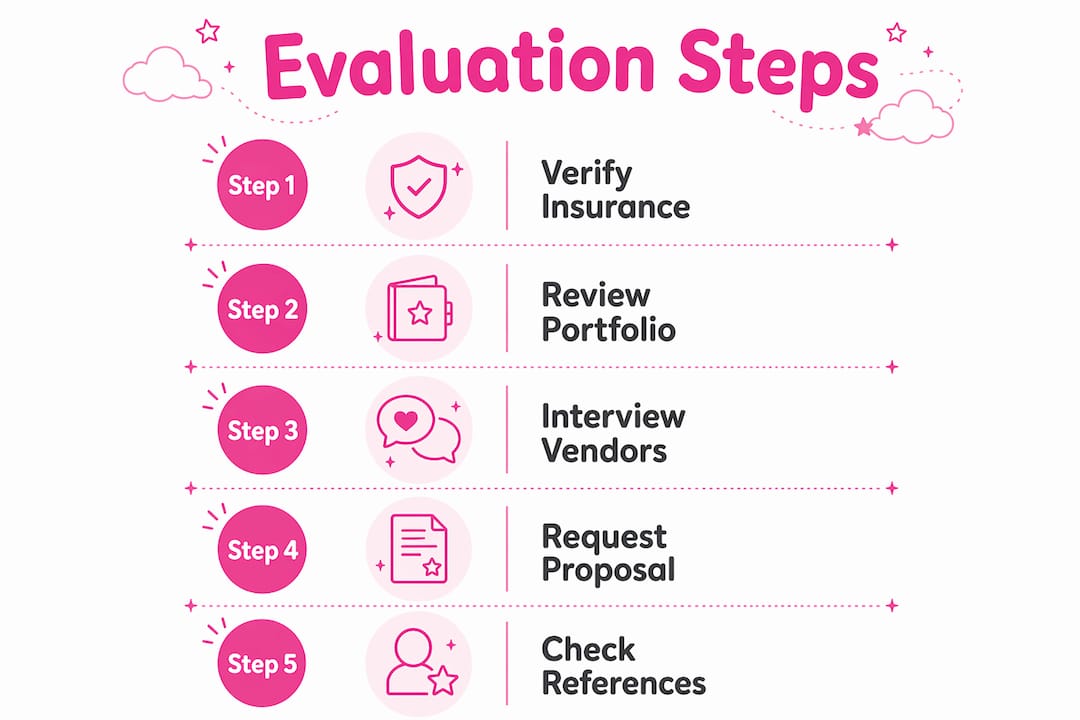
Pro Tip: Request a written proposal rather than a verbal quote. The quality of a vendor’s written proposal, including how well they address your brief, is one of the clearest previews of how they will manage your event.
Step-by-step process for comparing and selecting the best entertainment vendor
A clear selection process protects you from decision fatigue and gives you a defensible record if a booking goes sideways. Follow these steps in order.
-
Build a longlist. Gather at least six to eight candidates from referrals, industry directories, and portfolio searches. Do not shortlist yet. Volume at this stage gives you genuine comparison points.
-
Apply your criteria checklist. Score each vendor against your six core criteria: experience, insurance, references, technical fit, pricing, and contract terms. Use a simple 1-5 scale. Any vendor scoring below 3 on insurance or technical fit is out.
-
Request detailed proposals. Send your event brief to your top four candidates and ask for written proposals. Proposals should address your audience size, venue constraints, programme timing, and contingency arrangements.
-
Evaluate proposals against your objectives. Compare proposals against your event goals and budget, not just price. The cheapest proposal that ignores your brief is the most expensive mistake you can make.
-
Confirm venue technical compatibility. Consult venue managers early to confirm sound, lighting, and staging feasibility before you shortlist further. A vendor who has not asked about your venue’s technical specifications by this stage is not ready for a corporate booking.
-
Check contract terms carefully. Vendor contracts must cover cancellation terms, force majeure, key person clauses (what happens if the named performer cannot attend), and payment schedules. Do not sign anything that leaves these points open.
-
Book and confirm in writing. Pay the standard 50% deposit only once all contract terms are agreed and signed. Keep a copy of every document exchanged.
-
Schedule a post-event debrief. Preferred Vendor Lists should be reviewed quarterly using scoring from structured post-event debriefs. Vendors scoring below 3.5 on your debrief scorecard should be removed from future consideration. This step is what separates planners who repeat mistakes from those who build genuinely reliable vendor networks.
For corporate family day events that include children’s entertainment, Dreamscape’s corporate entertainers in Melbourne offer a useful benchmark for what a well-documented, fully insured, and audience-specific vendor looks like in practice.
Common mistakes when evaluating entertainment vendors and how to avoid them
Most booking disasters trace back to one of five avoidable errors. Recognising them before you start saves you from learning them the hard way.
- Ignoring venue technical constraints. A vendor’s performance history means nothing if their act cannot work in your venue. Confirm ceiling height, power access, sound restrictions, and sightlines before you progress any vendor past the proposal stage.
- Accepting generic quotes. A quote that does not reference your event brief is not a proposal. It is a rate card. Vendors who send generic rate cards without engaging with your brief are signalling that they will manage your event the same way.
- Skipping contract detail. Cancellation terms, payment schedules, and force majeure clauses are not optional extras. They are the difference between a recoverable problem and an unrecoverable one.
- Choosing passive entertainment formats. Audience participation formats lead to higher event recall than passive watching, particularly for groups of 50-400. An act that keeps your guests watching from their seats is rarely the act they remember.
- Failing to verify insurance. Public liability and workers compensation certificates are non-negotiable. A vendor without them exposes your organisation to direct liability.
Pro Tip: Document every communication with a vendor in writing, including verbal agreements confirmed by email. If a dispute arises, your paper trail is your only reliable evidence.
Key takeaways
Selecting the right entertainment vendor for a corporate event requires verified credentials, a written proposal process, and a structured post-event scoring system to build a reliable preferred vendor list.
| Point | Details |
|---|---|
| Verify insurance first | Collect public liability and workers compensation certificates before any other evaluation step. |
| Match entertainment to venue | Confirm ceiling height, acoustics, and staging with venue managers before shortlisting vendors. |
| Demand written proposals | Generic rate cards signal a transactional vendor. Detailed proposals signal a professional one. |
| Prioritise audience participation | Interactive formats produce higher event recall than passive acts, especially for groups of 50-400. |
| Score vendors post-event | Structured debrief scoring builds a reliable preferred vendor list and removes underperformers quarterly. |
What I have learned from years of watching corporate entertainment bookings go wrong
The most common mistake I see is planners treating entertainment as the last item on the checklist. It gets booked after the venue, the catering, and the AV, which means it gets booked in a hurry with whatever vendor is still available. That is exactly backwards. Entertainment is what your guests will remember and talk about. Everything else is infrastructure.
The second thing I have noticed is that planners consistently underestimate the value of the post-event debrief. Most people do a debrief on the event itself but not on individual vendors. A structured vendor scorecard, completed within 48 hours of the event while the details are fresh, is the single most useful tool for building a preferred vendor list that actually works. Without it, you are relying on memory and gut feel, neither of which is reliable six months later when you are booking the next event.
The third observation is about specialisation. A vendor who has done 200 weddings is not automatically qualified for a corporate gala. The audience dynamics, the programme structure, the MC relationship, and the technical requirements are genuinely different. Corporate entertainment specialists demonstrate that difference in how they talk about your event, not just in their portfolio images. Ask them to describe a corporate event that went wrong and how they fixed it. The answer tells you everything.
- Lauren
Dreamscape’s approach to corporate event entertainment
Corporate event planners who need family-friendly entertainment for company days, school events, or staff celebrations with children will find Dreamscape a genuinely useful starting point.
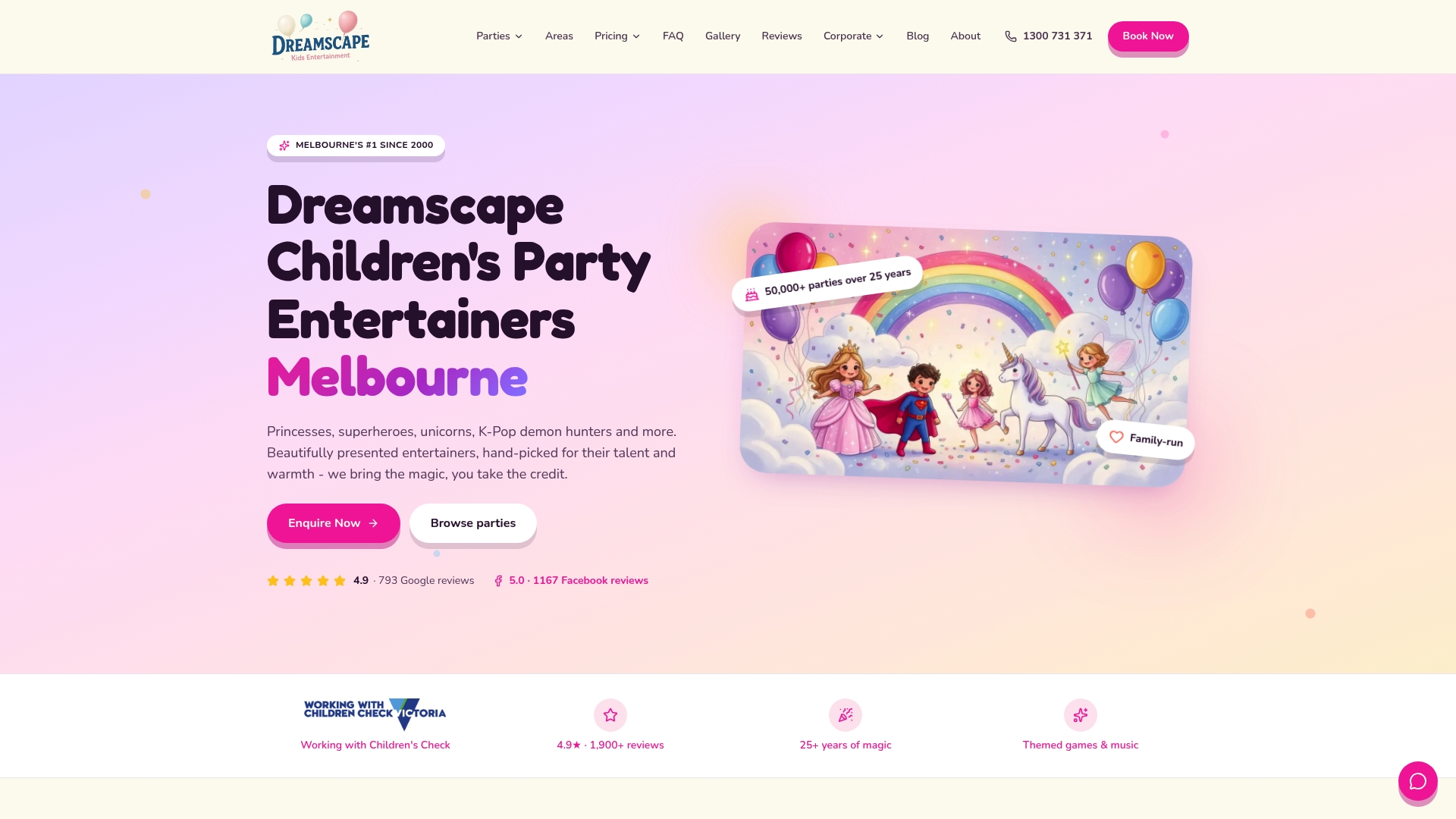
Dreamscape has delivered corporate family day entertainment across Melbourne for over 25 years, with more than 1,900 five-star reviews and full Working With Children compliance for every entertainer. Their themed character acts, including princesses, superheroes, and interactive performers, are built specifically for mixed-age corporate audiences where engagement and safety matter equally. Pricing is published transparently, and every booking comes with clear contract terms. For planners who want to see what a fully vetted, audience-specific entertainment vendor looks like, Dreamscape’s party packages offer a practical reference point for scoping your own vendor requirements.
FAQ
What are the most important criteria for evaluating entertainment vendors?
The six core criteria are corporate event experience, public liability and workers compensation insurance, verified references, venue technical compatibility, transparent pricing, and clear contract terms covering cancellation and force majeure.
How much does corporate entertainment typically cost in Australia?
Corporate entertainment in Australia generally ranges from $1,500-$4,000 + GST for emerging acts, $4,000-$8,000 + GST for established professionals, and $8,000+ + GST for celebrity acts, with a 50% deposit standard across all tiers.
Why does audience participation matter when choosing entertainment?
Interactive formats produce higher event recall than passive acts, particularly for groups of 50-400 guests. Entertainment that keeps audiences watching from their seats is rarely what they remember or discuss afterwards.
What contract terms should I check before booking an entertainment vendor?
Contracts must explicitly cover cancellation terms, force majeure clauses, key person provisions, full scope of work, and payment schedules. Vague agreements on any of these points create disputes that are difficult to resolve after the event.
How do I build a reliable preferred vendor list over time?
Score each vendor using a structured debrief completed within 48 hours of the event. Review your preferred vendor list quarterly and remove any vendor scoring below 3.5 to keep the list current and reliable.
Recommended
Planning a Melbourne party?
We will get right back to you.