

Discover eight fun Demon Slayer party games perfect for kids! Keep the energy high with themed activities that captivate and entertain.
Demon Slayer party games: 8 ready-to-run ideas
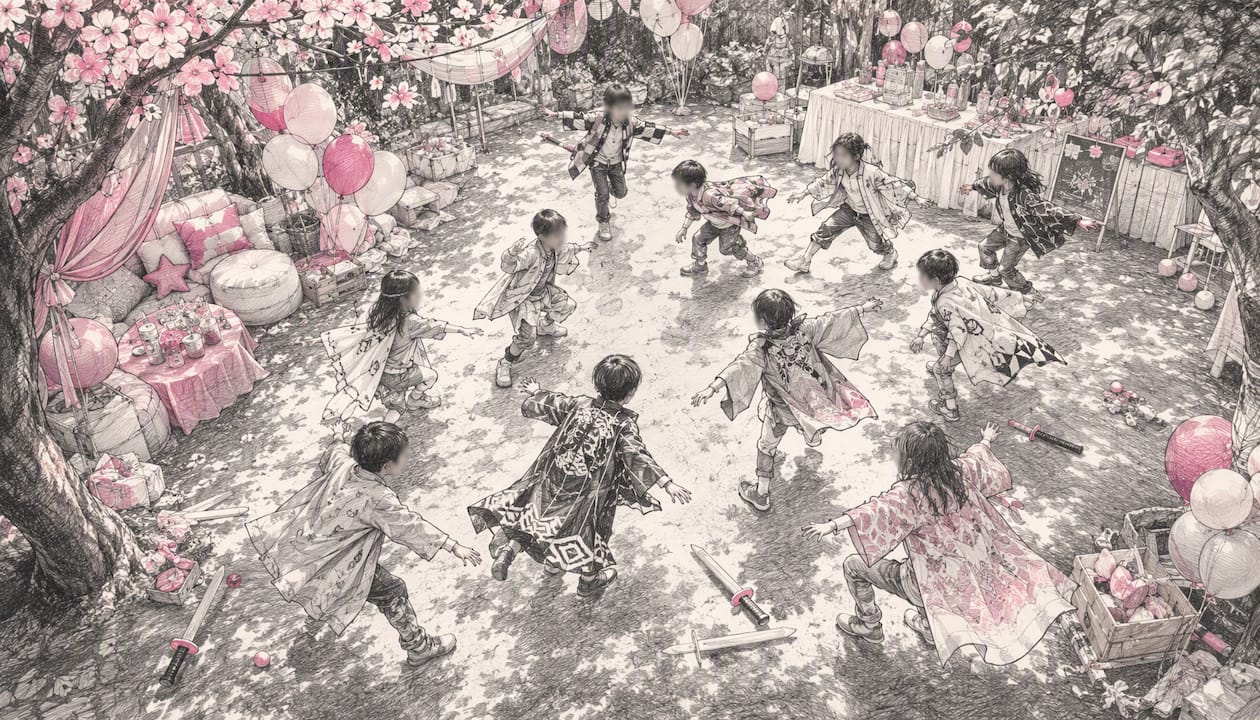
Eight Demon Slayer party games work brilliantly for young children, keeping the energy high while focusing entirely on the show’s visual magic - haori patterns, cherry blossoms, and beloved characters - rather than its MA15+ storylines. Run two or three of these back-to-back and you have a 90-minute party that feels genuinely themed without a single scary scene.
Here is the at-a-glance shortlist:
- Breathing Style Freeze Dance - freeze when the music stops; call out a “breathing style” pose. Ages 5-8.
- Demon Slayer Scavenger Hunt - find hidden character clues around the yard or house. Ages 5-10.
- Tanjiro Says (Simon Says variant) - follow Tanjiro’s commands only. Ages 5-7.
- Haori Pattern Bingo - match character colour patterns on printed bingo cards. Ages 6-10.
- Demon Slayer Trivia Challenge - character and story questions in team rounds. Ages 9-14.
- Stealth Tag (Muzan’s Demons) - one tagger, everyone else evades using slow-motion “breathing” moves. Ages 8-14.
- Character Costume Relay - race to dress in haori-style capes and pass the baton. Ages 6-12.
- Foam Sword Duel Tournament - structured bracket with foam swords and a referee. Ages 10-14.
Melbourne parents who prefer a hands-off option can book a themed party entertainer through Dreamscape, who supply foam-safe props, host-run games, and all the setup.
Key takeaways
Eight ready-to-run Demon Slayer party games cover ages 5-14 when you focus on the show’s visual aesthetic rather than its MA15+ storylines, giving every age group an age-appropriate and genuinely fun experience.
| Point | Details |
|---|---|
| Pick 2-3 games per party | Match game type to age: freeze dance and Tanjiro Says for under-8s, duel tournament and trivia for 10-14s. |
| Aesthetic over story content | Use haori patterns, character colours, and Nezuko’s non-violent traits; never screen MA15+ episodes for young guests. |
| Australian Classification guidance | The entire Demon Slayer series is rated MA15+ by the Australian Classification Board - the visual theme is safe, the series content is not. |
| Safety and supervision | Allow 2 metres per child for active games; foam props only; one adult per 6 children for ages 5-7. |
| Dreamscape for Melbourne bookings | Dreamscape supplies themed entertainers, foam-safe props, and host-run games with all WWCCs current and over 1,900 five-star reviews. |
Table of Contents
- What are the best Demon Slayer party games to run at home?
- How do you run the party so the timing actually works?
- How do you create the Demon Slayer look without scary imagery?
- Where do you buy Demon Slayer party supplies in Australia?
- Is Demon Slayer age-appropriate for a kids’ party in Australia?
- What printables do you need for a Demon Slayer party?
- Why the aesthetic-first approach works: an entertainer’s perspective
- What parents actually notice after the party
- Dreamscape makes the Demon Slayer theme easy for Melbourne families
- Sources
- FAQ
What are the best Demon Slayer party games to run at home?
The eight games above cover the full age range, but the rules and materials are what make or break them. Below is each game with a full set-up, timing estimate, and budget-friendly substitutions built in.
Breathing Style Freeze Dance
What kids do: Dance freely to an anime playlist, then freeze in a dramatic “breathing style” pose when the music cuts. The host calls out a style - Water, Flame, Thunder - and kids hold that pose until the music restarts.
Set-up: A Bluetooth speaker and a Spotify playlist of Demon Slayer OST tracks. No materials needed. Clear a 3 x 3 metre floor space.
Timing: 8-10 minutes. Ages 5-8: no elimination, just silliness. Ages 9-12: last one to freeze sits out each round.
Demon Slayer scavenger hunt
What kids do: Follow a series of character-themed clues hidden around the party space to find a “final mission scroll” and a small prize.
Set-up: Print 8-10 clue cards (A6 size, cardstock) using a free Canva template with haori-pattern borders. Each clue references a character trait rather than a violent scene - for example, “Nezuko protects her friends; find where the party host keeps the snacks.” Hide clues 20-30 minutes before guests arrive.
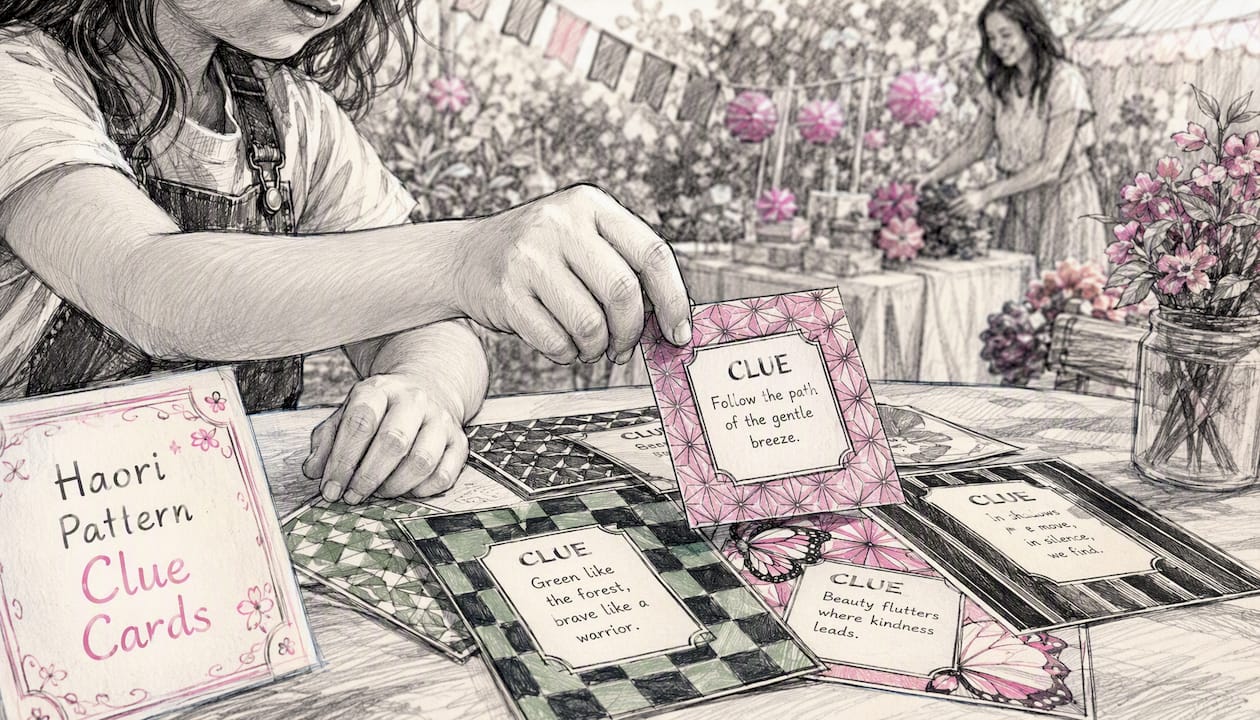
Timing: 15-20 minutes. Ages 5-7: run in pairs with a parent helper reading clues aloud. Ages 10-14: add a cipher or riddle layer to each clue.
Budget substitution: Write clues on plain card with a green-and-black checkered border drawn in marker. Total cost: under $3.
Tanjiro Says
What kids do: A Simon Says variant where the host plays Tanjiro and calls commands. Kids only follow if the host says “Tanjiro says” first.
Set-up: Zero materials. The host wears a green-and-black headband (cut from felt, $2 at a craft store). Works indoors or outdoors.
Timing: 5-8 minutes as a warm-up. Ages 5-7: keep commands physical and simple (jump, spin, crouch). Ages 8-12: add breathing-style poses as commands.
Haori Pattern Bingo
What kids do: Match character colour patterns called by the host to squares on their bingo card. First to complete a row calls “Total Concentration!”
Set-up: Design 5 x 5 bingo cards in Canva using colour swatches and character silhouettes. Print one per guest on A4 cardstock. Provide counters (dried beans, buttons, or small stickers work fine). Prepare a call list of 25 pattern descriptions.
Timing: 10-15 minutes. Works for all ages; younger kids benefit from picture-only cards rather than text descriptions.
Demon Slayer trivia challenge
What kids do: Split into teams and answer character, location, and story questions in three rounds. Teams earn “Breathing Points” for correct answers.
Set-up: Prepare 20-30 questions on index cards or a printed sheet. Downloadable Demon Slayer trivia question sets are available on Etsy and Teachers Pay Teachers for $3-$8. A whiteboard or large paper for scoring is all you need.
Timing: 20-25 minutes. Ages 9-12: focus on character names, colours, and abilities. Ages 13-14: include story arc questions and harder lore.
Stealth Tag (Muzan’s Demons)
What kids do: One player is “Muzan” and tries to tag others. Tagged players must move in slow-motion “breathing mode” for 30 seconds before rejoining. Last untagged player wins.
Set-up: An open backyard or hall. Mark boundaries with chalk or cones. No props required, though foam swords for the tagger add theatre.
Timing: 10-15 minutes. Ages 8-10: use a soft pool noodle instead of a tag. Ages 11-14: add a second tagger after two minutes.
Character Costume Relay
What kids do: Teams race to put on a haori-style cape, run to a cone, return, and pass the cape to the next player.
Set-up: Two haori-style capes (sew or buy; patterned fabric capes cost $8-$15 each at Spotlight or online). Mark a 10-metre relay lane. Works best outdoors.
Timing: 8-10 minutes per round. Run two rounds so every team gets a second attempt.
Foam Sword Duel Tournament
What kids do: A bracket-style tournament where pairs duel with foam swords. A referee (the host or an entertainer) calls points for clean touches to the shoulder or arm only.
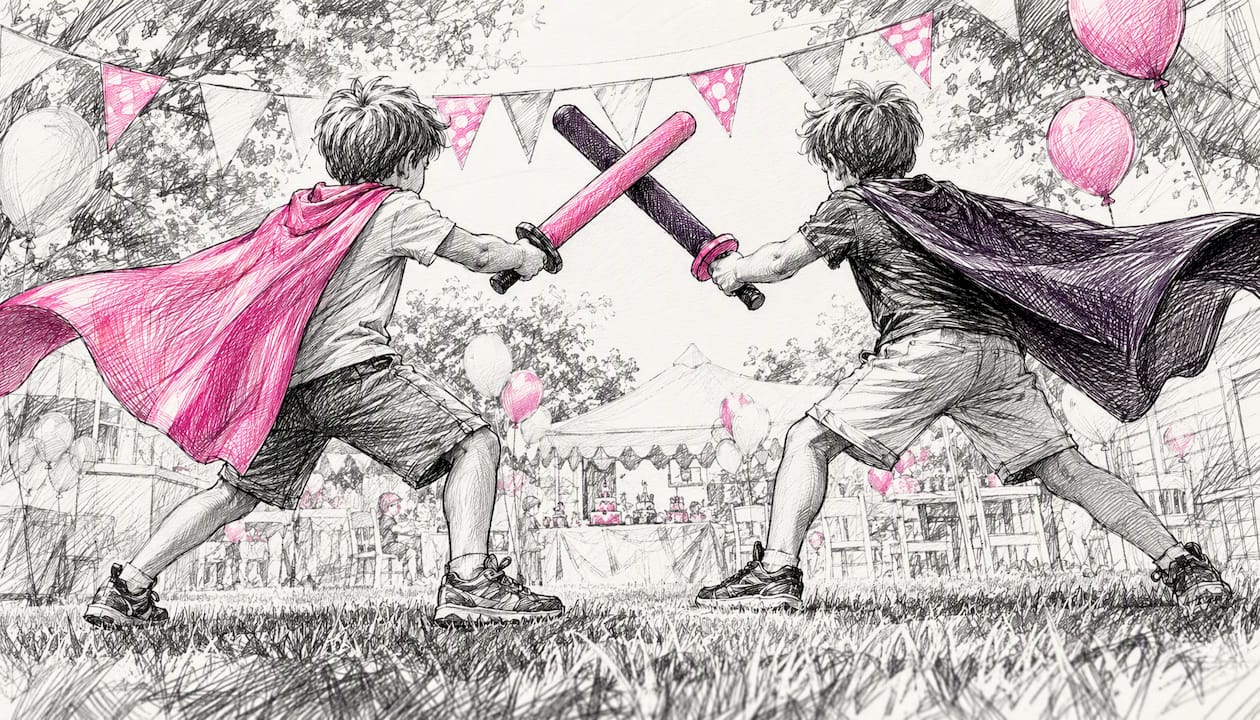
Set-up: Two foam swords ($5-$12 each at toy stores or online). A printed bracket sheet. Clear a 2 x 4 metre duelling space. Establish rules before starting: no head shots, no running, three points wins.
Timing: 20-30 minutes for 8-12 players. Best for ages 10-14 with clear adult supervision.
Pro Tip: Split mixed-age groups by pairing older kids as “mentors” in the relay and trivia games rather than separating them entirely - it keeps the group together and gives teens a role they actually enjoy.
| Game | Age range | Duration | Key materials | Budget |
|---|---|---|---|---|
| Breathing Style Freeze Dance | 5-8 | 8-10 min | Speaker, playlist | Free |
| Scavenger Hunt | 5-10 | 15-20 min | Printed clue cards | Under $5 |
| Tanjiro Says | 5-7 | 5-8 min | Felt headband | Under $3 |
| Haori Pattern Bingo | 6-10 | 10-15 min | Printed bingo cards, counters | Under $5 |
| Trivia Challenge | 9-14 | 20-25 min | Question cards, scoreboard | $3-$8 |
| Stealth Tag | 8-14 | 10-15 min | Pool noodle or foam sword | Under $10 |
| Character Costume Relay | 6-12 | 8-10 min | Two haori capes | $8-$15 |
| Foam Sword Duel | 10-14 | 20-30 min | Two foam swords, bracket | $10-$25 |
How do you run the party so the timing actually works?
A 90-120 minute party is the sweet spot for primary-school-aged children. Open with a high-energy game, move into a focused activity, break for food, then wind down with bingo or trivia before cake. Free play fills the last 15 minutes while parents arrive.
For a practical guide to managing energy levels across the full event, the complete party games guide from Dreamscape covers pacing in detail.
Recommended game order:
- Breathing Style Freeze Dance (energiser, 8-10 min)
- Scavenger Hunt or Stealth Tag (main activity, 15-20 min)
- Food break (15-20 min)
- Haori Bingo or Trivia (calmer activity, 10-15 min)
- Cake and singing (10 min)
- Foam Sword Duel or Costume Relay (optional finale for older kids, 20 min)
- Free play and pack-up (15 min)
| Time slot | Activity | Duration | Group size notes |
|---|---|---|---|
| Welcome and arrival | Freeze Dance warm-up | 8-10 min | Works for 6-20 kids |
| Main game block | Scavenger Hunt or Stealth Tag | 15-20 min | Split into 2 teams for 12+ kids |
| Food break | Snacks and drinks | 15-20 min | All sizes |
| Calm activity | Bingo or Trivia | 10-15 min | Teams of 3-5 work best |
| Cake | Singing and cutting | 10 min | All sizes |
| Optional finale | Duel Tournament or Relay | 20-30 min | 8-14 kids; skip for under-8s |
| Pack-up | Free play | 15 min | All sizes |
Roles: One lead host runs the games and holds the microphone energy. An assistant manages props, resets clue cards, and keeps the queue orderly during the duel tournament. A hired entertainer from Dreamscape can fill both roles simultaneously, which frees parents to take photos and enjoy the party rather than referee it.
For small groups of 6-8, skip the team-split format and run every game as a whole group. For large groups of 12-20, divide into two teams from the start and rotate them through parallel stations.
How do you create the Demon Slayer look without scary imagery?
The series has a rich visual identity that works beautifully for a children’s party when you focus on pattern, colour, and character rather than battle scenes.
Visual elements to borrow safely:
- Tanjiro’s green-and-black checkered haori pattern (use as tablecloth fabric, bunting, or balloon ribbon)
- Cherry blossom motifs (paper flowers, printed backdrops, pink balloon clusters)
- Character colour palettes: Tanjiro’s teal and black, Nezuko’s pink and white, Zenitsu’s yellow and white
- Wisteria flowers (purple paper garlands or silk flowers - wisteria repels demons in the story, a fun non-violent detail kids love)
- Foam “swords” as prop decorations, not weapons
Invitations: Canva’s free template library includes Japanese-aesthetic designs that you can customise with haori-pattern borders and cherry blossom graphics. Keep the wording light - “Join us for a Demon Slayer adventure!” rather than referencing specific battle arcs. Add a short note for parents: “This is a character-themed party inspired by the visual style of Demon Slayer. The series is rated MA15+ in Australia, so we’re keeping the party age-appropriate and fun.”
Costume and prop safety: Foam swords, haori-style capes, and character masks are all fine. Avoid sharp or rigid props, and skip face paint for children under three due to skin sensitivity. Haori capes made from lightweight fabric are easy to sew from a rectangle of patterned material - no pattern required.
Pro Tip: For a small indoor space, hang a single cherry blossom backdrop (a $15-$25 printed fabric banner from an online marketplace) and cluster character-coloured balloons in front. It photographs beautifully and takes ten minutes to set up.
Where do you buy Demon Slayer party supplies in Australia?
Sourcing is easier than it was a few years ago, though lead times matter if you are ordering online.
Budget tier (under $20 total): Print your own decorations and game cards using Canva or free templates from Pinterest. Buy plain coloured balloons and ribbon in character colours from a local party store like Party Supplies Australia or Spotlight. A roll of green-and-black checkered fabric from Spotlight ($4-$6 per metre) doubles as a tablecloth and a cape.
Mid-range ($20-$80): Licensed Demon Slayer party packs (plates, cups, napkins, banners) are available on Amazon Australia and eBay Australia, typically $15-$35 per pack. Foam swords and character masks appear regularly on Kmart.com.au and Big W’s website for $5-$15 each. Etsy sellers based in Australia offer printable packs (bingo cards, scavenger hunt clues, character labels) for $5-$15 per download.
Premium ($80+): Full costume sets and licensed haori replicas are available through costume hire shops in Melbourne and Sydney, or through online retailers like Costume Box Australia. Allow 5-10 business days for delivery on costumes and custom prints, especially if ordering from interstate.
When searching online, use terms like “Demon Slayer party decorations Australia” or “anime party supplies Australia” to filter for local stock. Check whether listings are licensed merchandise or aesthetic-only designs - both work for a party, but licensed goods tend to have sharper print quality.
Is Demon Slayer age-appropriate for a kids’ party in Australia?
The short answer: the aesthetic is perfectly fine for children of any age; the series itself is not for young kids.
The Australian Classification Board rates Demon Slayer: Kimetsu no Yaiba as MA15+ for strong supernatural themes and animated violence. The Mugen Train arc carries the same MA15+ classification with particular intensity, and later arcs including Infinity Castle reiterate those same advisory notes. None of the series should be screened for guests under 15 at a party.
What you can use freely: the colour palettes, haori patterns, character names, cherry blossom imagery, and non-violent character traits. Nezuko Kamado, for instance, is defined by her refusal to harm humans and her protective instincts - traits that make her an ideal visual centrepiece for decorations and games aimed at younger children.
Adaptation checklist:
- Remove: graphic imagery from the show, battle-scene screenshots, scary audio clips from fight scenes
- Keep: character colours, haori patterns, wisteria motifs, character names and friendly personality traits
- Replace: combat-focused game mechanics with role-play, relay, and trivia formats
Safety checklist for physical games:
- Minimum 2 metres of clear space per child for active games
- One adult supervisor per 6 children for ages 5-7; one per 8-10 for ages 8-12
- Foam props only - no rigid or sharp items
- Check for food allergies before serving themed snacks
- Brief all children on rules before each game; have a calm-down script ready (“Breathing mode - slow and steady”)
For ages 5-7, the scavenger hunt and Tanjiro Says are the safest picks. For ages 10-14, the duel tournament and stealth tag work well with clear rules and an adult referee. Matching the theme complexity to the child’s age is worth thinking through early - the choosing the right party theme guide from Dreamscape walks through that decision in detail.
What printables do you need for a Demon Slayer party?
A single printable pack prepared the night before covers everything. Here is the core checklist:
- Bingo cards - one per guest, 5 x 5 grid, character colour patterns as squares
- Scavenger hunt clue cards - 8-10 cards, A6 size, printed double-sided with a clue on one side and a character image on the other
- Trivia question sheet - one per team, 20-30 questions, sorted by difficulty
- Character name labels - for lolly bags, water bottles, and place settings
- Scoring tokens - small circles printed with “Breathing Points” text; cut and laminate
- Winner certificates - one template, personalised with the child’s name
Print specs: A4 cardstock (200 gsm) for bingo cards and certificates; standard 80 gsm paper for clue cards and trivia sheets. Laminate bingo cards if you plan to reuse them with dry-erase markers.
For 10 guests, budget for roughly 12 bingo cards, 10 clue sets, 4 trivia sheets (one per team), and 15 certificates. Dreamscape’s printable resources include scavenger hunt and bingo templates you can download and customise.
Free options: Canva’s free tier handles bingo cards and labels well. Paid packs on Etsy ($5-$15) typically include the full suite in a cohesive design.
Pro Tip: Print everything in one A4 sheet-per-page layout first, then scale down to A6 for clue cards using your printer’s “multiple pages per sheet” setting. You save paper and the cards are the right size without any cutting guides.
Why the aesthetic-first approach works: an entertainer’s perspective
Professional children’s entertainers who run anime-themed parties consistently find that kids respond to recognition more than story accuracy. When a child spots Tanjiro’s checkered pattern on a cape or hears Nezuko’s name called in a game, the excitement is immediate - they do not need a battle scene to feel the theme.
Dreamscape’s entertainers hold current Working With Children Checks and bring over 25 years of experience running themed parties for Melbourne families. With more than 1,900 five-star reviews, the team has handled everything from princess parties to K-Pop Demon Hunter events - the latter being the closest match to a Demon Slayer aesthetic in their current roster.
When booking any entertainer for an anime-themed party, ask three things: Do they hold a current Working With Children Check? Have they run anime or action-hero themed parties before? Do they supply foam-safe props, or do you need to provide your own?
Pro Tip: Book your entertainer at least four weeks out if the party falls on a Saturday between October and February - Melbourne’s peak party season fills fast, and themed entertainers with specific prop sets get booked earliest.
What parents actually notice after the party
The games matter less than the energy in the room. Kids remember whether the host was enthusiastic, whether they got to wear a costume, and whether there was a moment that felt genuinely exciting - a trivia question they knew the answer to, a duel they won, a scavenger hunt clue that made them laugh.
Mixed-age groups are the trickiest part of any themed party, and Demon Slayer ones are no exception. Older kids who know the series well can feel patronised by simplified games, while younger ones get lost in lore-heavy trivia. The fix is not separate programmes - it is giving older kids a role. Make a 12-year-old the “Breathing Style Judge” in the freeze dance, or the scorekeeper in trivia. They stay engaged, the younger kids look up to them, and the host has one less job.
Last-minute substitutions happen at every party. If a prop goes missing or a game runs short, the simplest fallback is always a call-and-response chant: the host calls a character name, kids shout a catchphrase or pose. It costs nothing, fills two minutes, and the kids love it every time.
Dreamscape makes the Demon Slayer theme easy for Melbourne families
Pulling together foam props, printed game cards, a themed costume, and a two-hour run sheet is genuinely a lot of work - especially when you also want to enjoy the party. Dreamscape’s Melbourne party entertainment packages handle all of it.
For a Demon Slayer-style party, Dreamscape brings:
- A professional entertainer in a themed costume (K-Pop Demon Hunter or character-adjacent theme)
- Foam-safe props and game equipment supplied and managed by the entertainer
- Host-run games tailored to your guest age range, from freeze dance for five-year-olds to duel tournaments for teens
- Face painters and balloon artists available as add-ons
- Full set-up and pack-down included
Every Dreamscape entertainer holds a current Working With Children Check. Pricing is transparent, and the team has over 1,900 five-star reviews from Melbourne families. Browse the full party themes and packages to see what fits your date and group size, then get in touch to lock in your booking.
Sources
FAQ
What Demon Slayer games work best for a kids’ party?
Breathing Style Freeze Dance, Haori Pattern Bingo, and the Demon Slayer Scavenger Hunt are the most versatile - they work for ages 5-12 with no materials beyond a speaker and some printed cards.
Is Demon Slayer appropriate for a children’s birthday party?
The series is rated MA15+ by the Australian Classification Board for strong supernatural themes and animated violence, so episodes should not be screened for young guests. The visual theme - character colours, haori patterns, and cherry blossoms - is entirely appropriate for children of any age.
Who is Nezuko and why is she a good choice for younger kids?
Nezuko Kamado is Tanjiro’s younger sister, known for her refusal to harm humans and her protective nature. Those traits make her the safest and most child-friendly character to feature in decorations and games.
How do you adapt Demon Slayer games for mixed ages?
Give older children a role - scorekeeper, judge, or team captain - rather than running separate games. This keeps the group together and lets younger kids look up to the older ones, which tends to settle the energy naturally.
Should I hire a professional entertainer for a Demon Slayer party?
If you have 10 or more guests or a mixed age range, a professional entertainer handles the pacing, props, and crowd management so you can focus on the day. Dreamscape offers themed party entertainment in Melbourne with all entertainers holding current Working With Children Checks.
Recommended
Planning a Melbourne party?
We will get right back to you.