
Discover how to plan an exciting anime party for kids with fun themes, delicious food, and engaging activities for a memorable celebration!
How to throw an anime party for kids
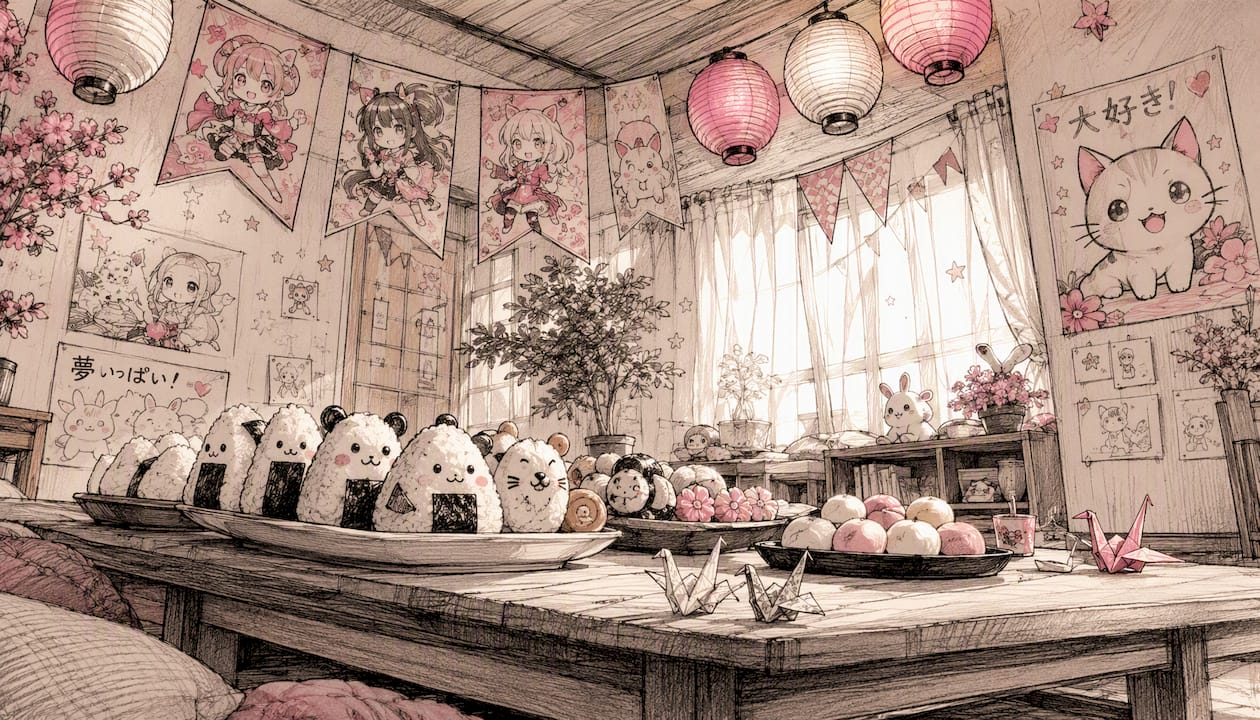
An anime party for kids is absolutely achievable, and the formula is simpler than most parents expect: pick a clear theme, set up a few key decor pieces, prepare kid-friendly food with allergy labels, run a small number of timed activities, and confirm that any entertainer you hire holds a current Working with Children Check (WWCC). Dreamscape Kids Entertainment has been running themed children’s parties in Melbourne for many years, so the blueprint below draws on real event experience alongside guidance from the Tasmanian Department of Health on food safety.
Here is what a typical anime-themed birthday covers:
- Theme anchor: one show or genre (Pokémon, Studio Ghibli, My Hero Academia) that shapes every other decision
- Decor: a backdrop or photo wall, themed tableware, and one hero installation
- Food: a mix of simple Japanese-inspired bites and familiar favourites, labelled for allergens
- Activities: 3-5 timed games with a clear run-sheet (arrival through wind-down)
- Favours: goodie bags matched to your budget tier
- Safety: entertainer WWCC confirmed before booking, dietary needs collected at RSVP
Key takeaways
A successful anime party for kids comes down to five things: a clear theme, one strong decor focal point, labelled allergy-safe food, a small number of timed activities, and a confirmed WWCC for any entertainer you hire.
| Point | Details |
|---|---|
| Pick one theme anchor | Choose a single show or genre and build decor, food, and costumes around its colour palette. |
| Collect dietary info at RSVP | Ask an open question about all dietary needs, not just allergies, and label every dish at the party. |
| Confirm WWCC before booking | Verify your entertainer’s check through the relevant state portal; rules differ by state and territory. |
| Run a small number of timed activities | Use a clear run-sheet from arrival to wind-down to manage energy and keep the party on track. |
| Dreamscape for hands-off planning | Dreamscape’s WWCC-verified Melbourne entertainers handle games, crowd management, and themed characters so parents can enjoy the party. |
Table of Contents
- What anime themes work best for a kids’ party?
- How do you decorate for an anime-themed birthday?
- What food should you serve at an anime kids’ party?
- What activities and games work for an anime party?
- How do you handle costumes and photo moments?
- What should you put in anime party goodie bags?
- Step-by-step planning checklist and sample budget
- How do you hire a safe entertainer for a kids’ anime party?
- Which anime shows are safe to screen for kids?
- Managing dietary restrictions beyond the basics
- What the numbers say about themed kids’ parties
- Dreamscape makes anime party planning easier for Melbourne families
- Sources
- FAQ
What anime themes work best for a kids’ party?
The most popular single-show themes right now are Pokémon, Studio Ghibli (particularly My Neighbour Totoro and Spirited Away), Sailor Moon, and My Hero Academia. For older primary-school kids, Demon Slayer is a strong pick for a demon slayer party, though parents should pre-screen episodes first given some intense scenes. Broader genre themes, like “magical girl,” “shonen tournament,” or “cosy Ghibli picnic,” work well when guests have mixed anime knowledge.
How to narrow it down:
- Age fit: Pokémon and Ghibli suit ages 4-10 broadly; My Hero Academia and Demon Slayer are better from age 8-9 upward
- Costume expectations: Ghibli and Pokémon have simple, recognisable costumes; Demon Slayer’s Tanjiro or Nezuko are popular but require more detail
- Food complexity: a Ghibli picnic theme allows simple, beautiful food; a tournament theme invites a ramen bar or “power-up” snack station
- Venue space: a tournament or shonen theme benefits from an open area for games; a cosy Ghibli theme works well in a lounge or garden
Pro Tip: Pick a colour palette first, then choose your theme. Pokémon’s red, yellow and white; Ghibli’s greens and creams; Sailor Moon’s pinks and golds. A consistent palette makes cheap decor look considered, and it removes the pressure on guests to nail a specific costume.
How do you decorate for an anime-themed birthday?
The core pieces that do the most work are a backdrop or photo wall, themed tableware, one hero installation, and a few printed props. You do not need everything to match perfectly; you need one focal point that reads “anime” immediately.
Core decor items:
- Backdrop or photo wall (manga panel print, character silhouettes, or a colour-block in theme colours)
- Themed paper plates, cups, and napkins in the show’s palette
- Table centrepiece: a balloon arch or character standee
- LED strip lights or paper lanterns in theme colours
- Printed A3 posters or manga-panel frames (easily made with Canva)
- “Wanted” or “character ranking” posters as interactive props
Quick setup checklist (60-90 minutes):
- Lay tablecloths and arrange tableware first
- Mount the backdrop or hang the photo wall
- Place the hero installation (balloon arch, standee, or centrepiece)
- Hang LED strips or lanterns around the perimeter
- Put out printed posters and prop items
- Set up the food station last, just before guests arrive
A real-world example of this approach: a Witch Hat Atelier birthday featured a balloon diamond arch, custom signage and themed tableware as the hero installation, with potion-making activity stations completing the look. One strong centrepiece plus consistent tableware is all it takes.
Pro Tip: Print A3 manga panels or character art at your local Officeworks for under $3 each. Frame three or four in matching black frames and you have a gallery wall that looks far more expensive than it is.
What food should you serve at an anime kids’ party?
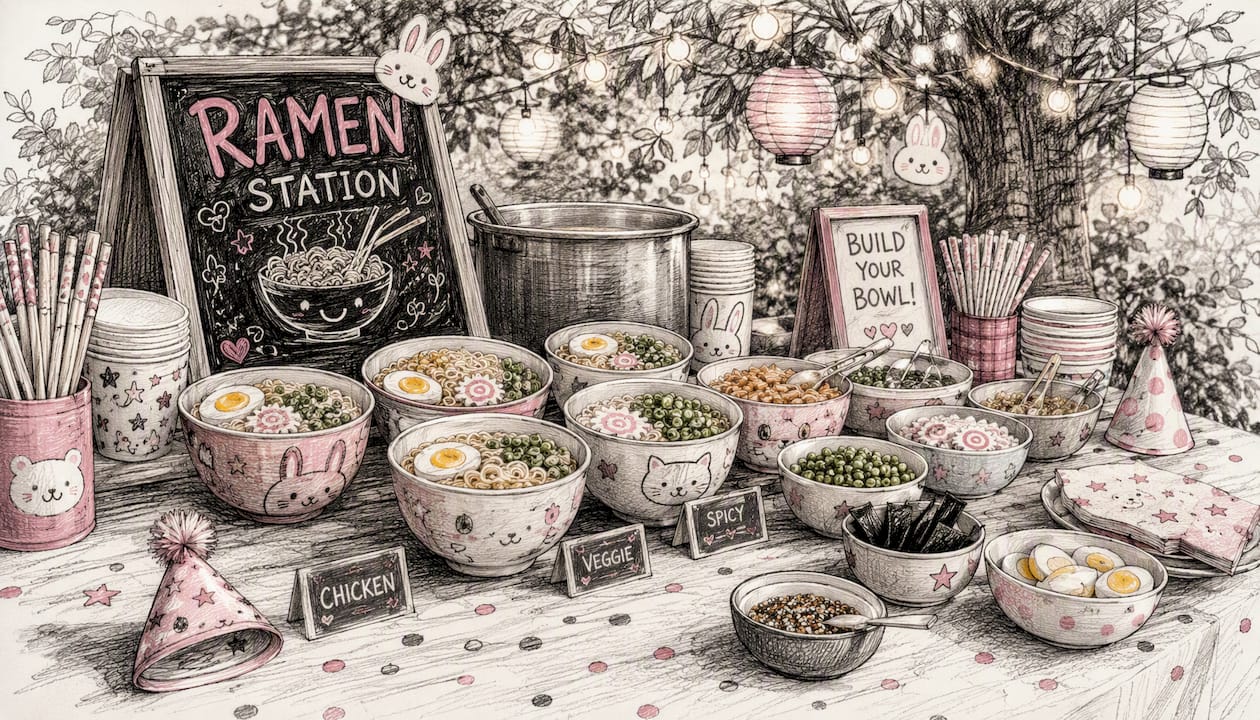
The sweet spot is a mix of simple Japanese-inspired bites and familiar, crowd-pleasing options. You do not need to cook ramen from scratch; the idea of a ramen bar (instant noodles in themed bowls with toppings set out) lands just as well with kids.
| Food item | Effort level | Allergen notes |
|---|---|---|
| Onigiri-style sandwiches | Low | Gluten (bread); can use GF bread |
| Candy sushi (rice krispie + fruit roll-up) | Low-Medium | Check for tree nut traces |
| Gyoza (store-bought, pan-fried) | Low | Gluten, soy, pork |
| Pocky sticks | Very low | Gluten, dairy, soy |
| Mochi-style ice cream | Low | Dairy, rice flour |
| Cupcake “power-ups” | Low-Medium | Gluten, dairy, eggs |
Food safety and allergy checklist:
- Collect dietary requirements from every family at RSVP, not on the day
- Label every dish clearly with its top allergens (gluten, dairy, eggs, nuts, soy)
- Keep fresh food cool with eskies and ice blocks when fridge space is limited
- Refrigerate or use leftovers within one to two days, following Tasmanian Department of Health guidance
- Keep children away from cooking and reheating areas
- Assign one adult to supervise and refill the food table rather than leaving platters unattended
Pro Tip: Set up a “build your own” station, such as a candy sushi roll or onigiri sandwich bar, and kids will spend 15 minutes happily occupied while you finish setup. It also sidesteps most allergen issues because each child controls what goes in theirs.
What activities and games work for an anime party?
A 90-120 minute party runs best with a clear run-sheet. Arrival and warm-up should take no more than 15 minutes; the main activity block 40-50 minutes; cake and photos 15-20 minutes; and a wind-down or free play period to close.
Sample run-sheet:
- Arrival + warm-up game (0-15 min): Anime opening quiz or “who’s that Pokémon” picture round
- Main activity block (15-60 min): Two or three games from the list below
- Cake + group photo (60-75 min): Candles, song, group shot at the backdrop
- Free play / photo-op (75-100 min): Cosplay runway or prop-based photo station
- Wind-down + favours (100-120 min): Quiet activity, goodie bags, farewells
Activity ideas with age ranges:
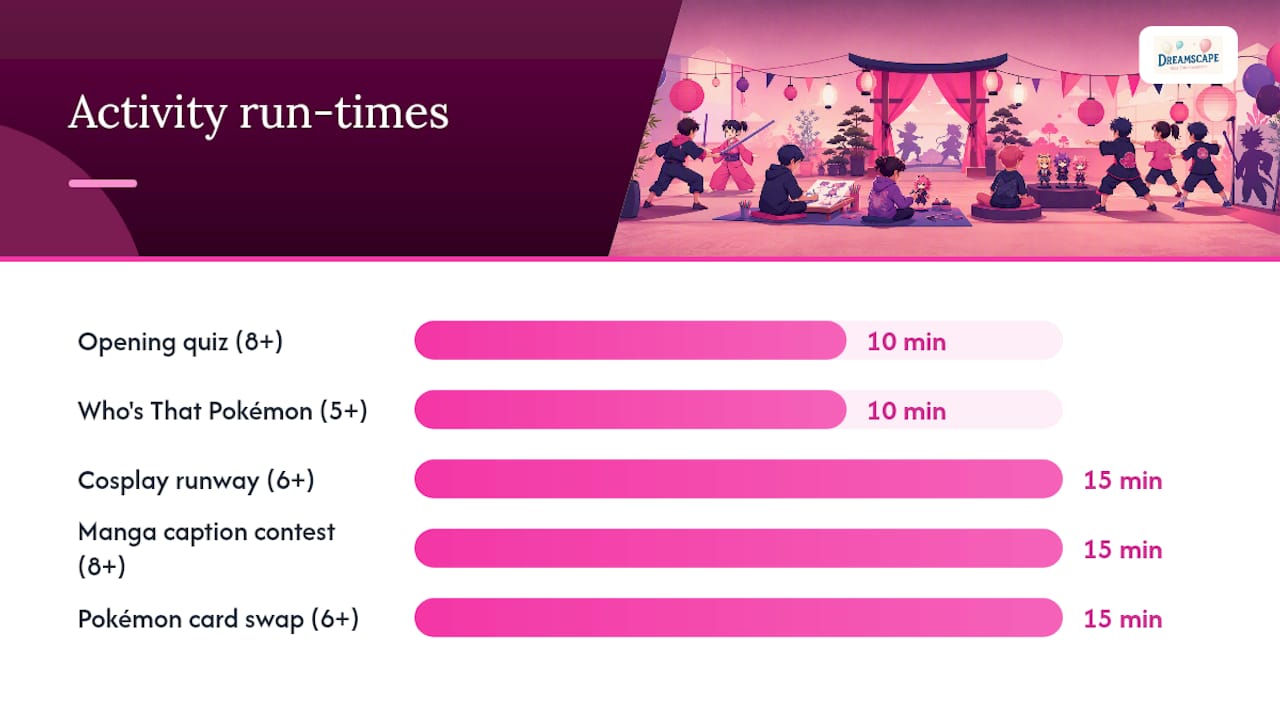
| Activity | Best age | Run-time | Materials needed |
|---|---|---|---|
| Anime opening quiz | 8+ | 10 min | Printed question cards or phone/speaker |
| “Who’s that Pokémon” silhouette round | 5+ | 10 min | Printed silhouette cards |
| Cosplay runway + judging | 6+ | 15 min | Runway space, small prizes |
| Tier-list station (rank your fave characters) | 8+ | 10 min | Printed tier-list sheets, stickers |
| Manga caption contest | 8+ | 15 min | Printed blank manga panels, pens |
| Ramen-eating relay | 6+ | 10 min | Chopsticks, bowls, soft noodles |
| Pokémon card swap/trade table | 6+ | 15 min | Guests bring spare cards |
| Anime charades | 5+ | 10 min | Character name cards |
Materials shopping list: printed question/silhouette cards, sticker sheets, blank manga panel printouts, chopsticks, small prizes (sticker packs, keyrings), a Bluetooth speaker for background music.
How do you handle costumes and photo moments?
Costume stress is real, and it kills the fun before the party starts. Offer three levels in the invitation so every family can participate without pressure:
- Level 1 - Colour theme: wear the show’s main colours (e.g. red and black for Demon Slayer, yellow and red for Pokémon)
- Level 2 - Accessories only: a headband, a cape, a Pokéball prop, or a printed character badge
- Level 3 - Full cosplay: full character costume for those who want it
For face paint, keep it simple and safe. Patch-test new face paints on a small skin area at least 30 minutes before applying to the face. Use dedicated face-paint brushes cleaned between each child, and avoid painting directly on lips or inside the eye area for children under five. Check that any face paint product is labelled cosmetic-grade.
Two photo moments that actually get shared:
Photo moment 1 - Group backdrop shot
- Large printed or fabric backdrop in theme colours or manga-panel style
- Props: character masks on sticks, themed frames, oversized Pokéballs
- Best for: group shots, birthday child centrepiece photo
Photo moment 2 - Interactive prop station
- “Wanted” poster or “character power ranking” board with the birthday child’s name and stats
- Guests hold up their ranking card or step into a printed manga panel frame
- Best for: individual guest photos, social shares
For the best phone photos, position the backdrop opposite a window for natural light, or use a ring light if the party is indoors in the evening. The Game of Nerds’ anime party guide recommends two distinct setups exactly like this so every guest gets at least one shareable image.
Pro Tip: Shoot the group backdrop photo at the start of the party, not after cake. Hair is tidier, costumes are intact, and you are not chasing sugar-rushed kids around the room.
What should you put in anime party goodie bags?
Three budget tiers cover most situations. None of these need to be elaborate; the theme does the work.
Low budget (under $5 per child):
- Anime-character sticker sheet
- A pack of Pocky or Hello Panda biscuits
- A printed “character card” with the guest’s name and a made-up power stat
Mid budget ($5-$12 per child):
- Mini gacha/mystery bag (blind-bag toy or character keyring)
- Sticker sheet plus a small notepad with manga-panel cover
- A few pieces of Japanese candy (Meiji chocolate, Hi-Chew)
Premium (over $12 per child):
- Small craft kit (make-your-own bookmark, origami set, or mini canvas for character drawing)
- Character keyring or enamel pin
- Pocky, Hi-Chew, and a personalised character card
A few safety notes: avoid small figurines or loose beads for children under three due to choking risk. Check that any blind-bag toy is labelled for the correct age group. Hi-Chew and similar chewy sweets are not suitable for children with braces or very young toddlers.
Step-by-step planning checklist and sample budget
Planning backwards from the party date keeps everything manageable. For a cosplay or themed party, an appropriate lead time is the practical minimum.
Timeline:
- 6 weeks out: Book venue or confirm home space; book entertainer if using one; confirm theme
- 4 weeks out: Send invitations; include costume level guidance and dietary RSVP request
- 3 weeks out: Collect dietary requirements; order custom decor or printed items
- 1 week out: Final food shopping; build playlist; confirm entertainer booking and WWCC
- 1 day out: Set up decor, prep food items that keep overnight, charge speaker
- Day of: Set up food station 30 minutes before guests arrive; assign one adult to food supervision
Supplies checklist:
- Backdrop or printed poster set
- Themed tableware (plates, cups, napkins)
- LED strips or lanterns
- Printed activity cards and game materials
- Goodie bag items
- Esky/ice blocks for food safety
- Bluetooth speaker and playlist ready
Sample budget per child:
| Approach | Decor | Food | Activities/favours | Entertainer | Approx. total per child |
|---|---|---|---|---|---|
| DIY low-cost | $3-$5 | $5-$8 | $3-$5 | None | $11 |
| Mixed (DIY + hired face painter) | $5-$8 | $8-$12 | $5-$8 | $5-$10 | $27 |
| Professional entertainer included | $5-$8 | $8-$12 | $5-$8 | $15-$25 | $38 |
For Melbourne-specific entertainer pricing, Dreamscape’s kids’ party entertainer cost guide breaks down what you can expect to pay across package types.
How do you hire a safe entertainer for a kids’ anime party?
This is the step most parents leave too late. Treat WWCC compliance as a booking requirement.
Checklist when hiring an entertainer:
- Ask for their current WWCC or blue card number and verify it through the relevant state portal
- Confirm they hold public liability insurance
- Ask for at least two references from recent children’s events
- Clarify the scope of interaction: will they be in direct contact with children, leading games, or performing from a stage?
- Get the booking in writing with a clear cancellation policy
State differences matter. The Australian Government confirms that WWCCs are issued under state and territory laws, so names and processes differ. In Victoria, entertainment and party services for children are listed as child-related work (code 30) and usually require a WWCC unless the activity is merely incidental to another business purpose. In Queensland, entertainment and party services explicitly require a blue card, with staged application deadlines for existing providers from 20 September 2025. In WA, public performances without interactive elements may be exempt, but interactive shows involving physical contact with children require a check.
Note: Queensland introduced transitional application timeframes for entertainment and party service providers from 20 September 2025. If you are booking a Queensland-based entertainer, confirm their blue card status is current under the new rules.
Pro Tip: Ask the entertainer to send you a photo of their WWCC card before the party date. A professional will have it ready without hesitation. If there is any delay or deflection, that tells you something.
For a full child-safety checklist when booking party entertainment, Dreamscape’s child safety checklist for party entertainment covers the key verification steps.
Which anime shows are safe to screen for kids?
Not all anime is created equal, and a few popular titles are firmly in the older-teen bracket regardless of how familiar the characters look on merchandise.
Safe picks for ages 4-10:
- My Neighbour Totoro, Kiki’s Delivery Service, Ponyo (Studio Ghibli - gentle, no scary content)
- Pokémon (original series or newer seasons - very safe, episodic)
- Chi’s Sweet Home (very young children, short episodes)
- Doraemon (ages 5+, episodic, widely available)
Safe with pre-screening for ages 8+:
- My Hero Academia (some battle violence; most episodes fine for 8-9+)
- Demon Slayer (intense scenes and some horror elements; pre-watch before showing to under-10s)
Avoid for under-10s:
- Attack on Titan, Death Note, Fullmetal Alchemist: Brotherhood (mature themes, graphic violence)
Screening setup tips:
- Pre-watch the specific episodes you plan to show, not just the series in general
- Set volume at a comfortable level; anime soundtracks can spike suddenly
- Create a viewing area with cushions, clear sightlines, and enough floor space so kids are not crammed together
- Set up a quiet corner or separate space for children who get overwhelmed or need a break
- Have a non-screen activity available alongside the viewing area
Pro Tip: Use dubbed versions for children under seven. Reading subtitles and watching action simultaneously is genuinely hard for young kids, and they will lose the story within minutes. For older kids, subtitled versions are fine and often preferred.
Managing dietary restrictions beyond the basics
Food labelling covers the obvious allergens, but dietary restrictions at a kids’ party run wider than that. Vegetarian and vegan guests need more than just “no meat” options; halal and kosher requirements affect which brands of gelatine-based sweets and certain processed foods you can serve; and some children have texture sensitivities that make chewy or crunchy foods genuinely distressing.
Collect this information at RSVP with a simple open question: “Does your child have any dietary needs, allergies, or food preferences we should know about?” That phrasing catches restrictions parents might not think to mention if you only ask about allergies.
At the party, keep a separate, clearly labelled plate for any child with a specific requirement rather than asking them to navigate the main table. A small card with the child’s name and their safe foods, placed near their seat, removes any awkwardness. For children with severe allergies, confirm with the parent whether cross-contamination from shared serving utensils is a concern, and if so, serve their food first before the main spread is touched.
Gelatine is worth a specific mention: mochi-style sweets, gummy candies, and some marshmallows contain pork-derived gelatine, which affects both halal and vegetarian guests. Agar-based alternatives are widely available and swap in without any difference in presentation.
What the numbers say about themed kids’ parties
Running anime-style events over 25 years teaches you things no planning guide captures. The parties that go smoothest are not the ones with the most elaborate decor; they are the ones where the run-sheet is tight, the food is sorted before guests arrive, and the entertainer has done this before.
Dreamscape’s entertainers hold current WWCCs and bring the games, the energy, and the crowd-management experience that makes the difference between a party that flows and one that stalls at the cake. With over 1,900 five-star reviews from Melbourne families, the feedback is consistent: parents who hand off the entertainment spend the party actually enjoying it.
One practical suggestion from the planner’s playbook: brief your entertainer on the birthday child’s favourite character and one or two guests who might be shy. A good entertainer will work that into the session without being asked twice.
Dreamscape makes anime party planning easier for Melbourne families
Planning a themed party from scratch takes real time, and the activities, crowd management, and safety compliance are the parts that catch parents off guard. Dreamscape’s kids’ party entertainment packages cover all of it: professional entertainers in themed costumes (including K-Pop demon hunters and character performers), structured games and activities, music, and full group management for parties of any size.
Every Dreamscape entertainer holds a current WWCC, carries public liability insurance, and arrives with a plan. With 25+ years of children’s events experience and over 1,900 five-star reviews, Melbourne families book Dreamscape because the entertainer shows up prepared and the parents get to be guests at their own child’s party. Browse themed party characters and packages or get in touch to check availability for your date.
Sources
- Vic
- Party Food for Kids
- Working with children checks - Department of Education, Australian Government
- Working with children checks - culture and the arts sector (WA factsheet)
FAQ
What are some good ideas for an anime party?
Pick one show as your theme anchor, then build around a colour palette, a photo backdrop, 3-5 timed games (anime quiz, cosplay runway, manga caption contest), and simple Japanese-inspired food like candy sushi or onigiri-style sandwiches.
What anime shows are safe for young children?
Studio Ghibli films (My Neighbour Totoro, Kiki’s Delivery Service, Ponyo) and classic Pokémon episodes are very safe for ages 4-10. Pre-screen any episode of My Hero Academia or Demon Slayer before showing to children under nine.
What are some fun anime-themed games for kids?
“Who’s that Pokémon” silhouette rounds, anime opening quizzes, cosplay runways, and manga caption contests all work well. Keep each game to 10-15 minutes and have a fallback activity ready for mixed-age groups.
Do entertainers at kids’ parties need a Working with Children Check?
In most Australian states, yes. Victoria lists entertainment and party services as child-related work requiring a WWCC; Queensland requires a blue card for the same activities. Rules vary by state, so verify your entertainer’s check through the relevant state portal before the party date.
Recommended
Planning a Melbourne party?
We will get right back to you.