

Budget $35-$70 per guest for Melbourne corporate family days. See local cost bands, run sheets, safety checklist, and get a tailored entertainment quote.
Budget $35-$70 Per Guest: Melbourne Corporate Family Day Run Sheet
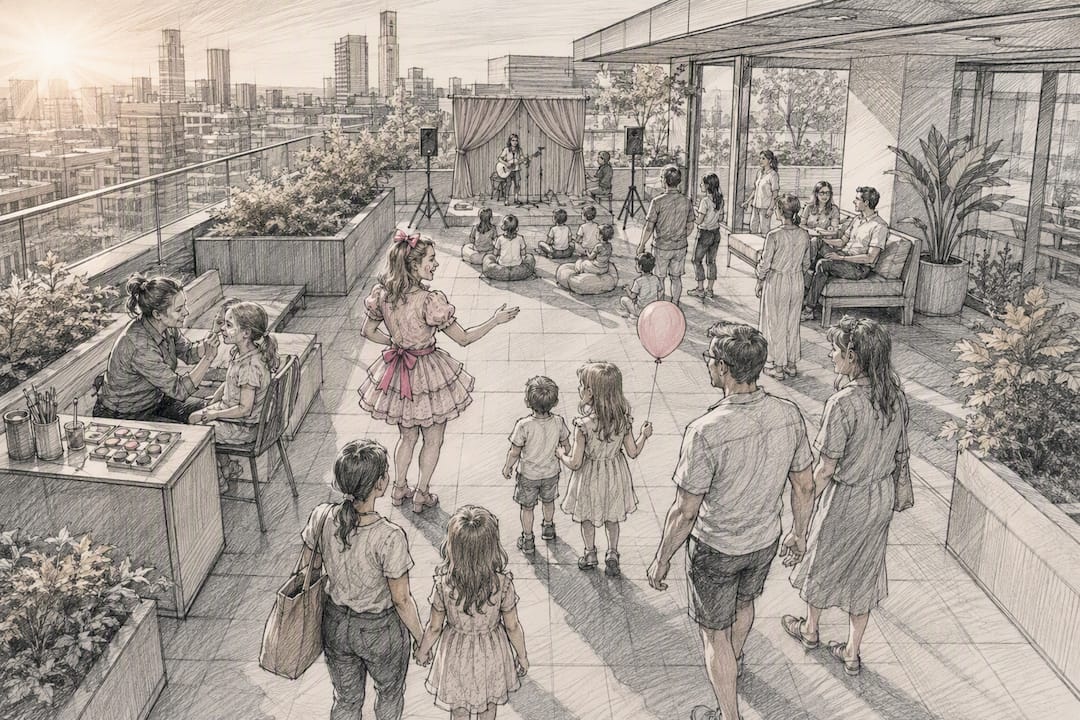
Budget roughly $35 to $70 per guest for entertainment on a corporate family day in Melbourne, depending on the mix of roving performers, face painting, a DJ, and any activity zones you add. Secure your entertainer bookings, first-aid cover, and base AV first. Then layer in extras like custom characters or a bigger activity footprint once the core spend is locked. Suppliers operate across Melbourne and can quote against your specific guest numbers and venue.
TL;DR:
- Booking Melbourne-based performers and bundling multiple acts with one supplier significantly reduces travel and setup fees, saving up to 15-25%.
- Entertainment costs vary by event size, with total spending around $1,450 for 100 guests, $7,290 for 300 guests, and $14,800 for 700 guests, with per-head prices decreasing as size increases.
- Seasonal demand and venue constraints can add 15-25% to quotes, especially during holidays, school breaks, or locations with limited access or power.
- Contracts should specify scope, overtime rates, and include a written breakdown of all costs, as extras like equipment hire and setup are often charged separately.
- Booking at least six to eight weeks early, fixing scope in writing, and requesting detailed itemized quotes are key to staying on budget and avoiding last-minute surprises.
Table of Contents
- What does corporate family day entertainment cost in Melbourne?
- What pushes your entertainment budget up?
- Sample budgets and run-sheets by event size
- Vetting and safety checklist before you book
- Melbourne venue factors that change your quote
- When to book and how to negotiate a better rate
- How a Melbourne supplier builds a typical quote
- What’s not in the headline quote
- Metro Melbourne vs suburban and regional pricing
- Building in a contingency buffer
- Where planners get this budget wrong
- Get a tailored quote for your corporate family day
- Sources
- FAQ
What does corporate family day entertainment cost in Melbourne?
Melbourne’s corporate family day entertainment market splits into fairly predictable price bands, and once you understand what sits in each one, building a budget stops being guesswork.
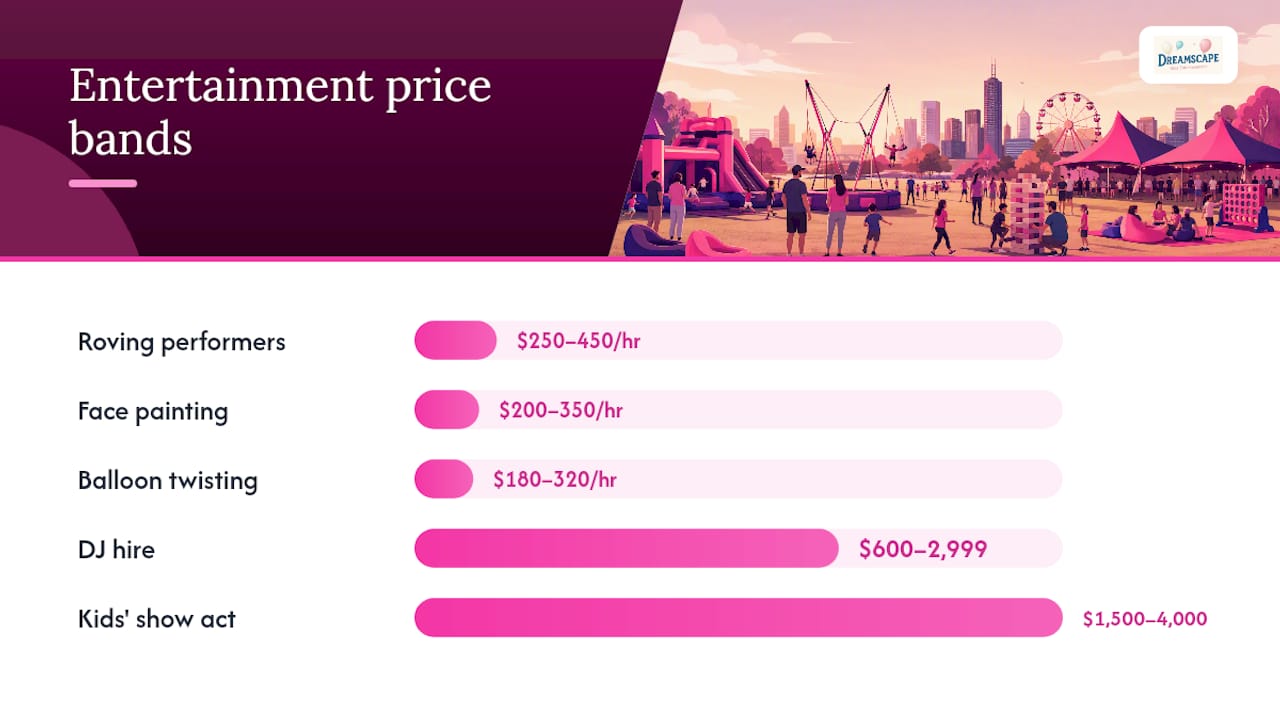
Roving performers (characters, magicians, balloon artists working the crowd) typically run $250 to $450 per hour, per performer, for bookings within metropolitan Melbourne. Most suppliers set a two-hour minimum. Face painting stations price similarly, usually $200 to $350 per hour depending on whether you want simple designs or full character transformations.
Balloon twisting as a standalone activity sits at $180 to $320 per hour. Pair it with face painting at the same station and some suppliers will shave 10 to 15% off the combined rate, since travel and setup only happen once.
Show acts, the staged performances with a script, costumes, and often a sound system, cost more because they need rehearsal time and production support. Broader industry pricing for professional live acts in Australia falls into rough bands: emerging or mid-tier acts run $1,500 to $4,000 plus GST, established professional acts sit at $4,000 to $8,000 plus GST, and celebrity or high-profile acts start above $8,000 plus GST. A kids’ show act for a family day will usually land at the lower end of that range unless you’re booking a recognised children’s entertainer with a television or streaming profile.
DJ hire for corporate events in Melbourne commonly ranges from about $600 to $2,999 depending on equipment and how much production you want. Many suppliers now offer fixed packages at moderate prices that bundle a basic-to-premium tier, which makes comparing quotes far easier than negotiating each inclusion separately.
Activity zone hire (inflatable games, giant Jenga, mini golf, soft-play for younger kids) generally costs $300 to $900 per zone for a half-day, with soft-play equipment at the higher end because of setup and cleaning requirements.
What’s usually included in these rates:
- A set booking length (typically two to four hours), with overtime charged in 30 or 60 minute blocks
- The stated number of performers or staff for that price
- Basic costume or kit relevant to the act
- Travel within metropolitan Melbourne (interstate or regional acts add a travel fee)
GST is added on top of most quoted rates unless a supplier states their price is GST-inclusive, so always ask before you compare two quotes side by side. Travel surcharges typically apply once a venue sits more than 40 to 50 kilometres from the CBD, and equipment hire for anything beyond a supplier’s standard kit (extra speakers, staging, generators) is usually itemised separately rather than folded into the headline rate.
What pushes your entertainment budget up?
Four factors drive most of the price variation you’ll see between quotes for what looks like the same service on paper.
- Date and season. School holidays, December, and Easter carry premium pricing across almost every entertainment category, because demand for family-friendly acts spikes at the same time schools and childcare centres are running their own events. Booking outside these windows, or locking in your date early within them, avoids surcharges that can add 15 to 25% to a quote.
- Travel and production complexity. Interstate acts add flights, accommodation, and per diems on top of the performance fee. Even locally, a staged show with lighting, a PA system, and a longer load-in window costs more than a roving performer who arrives with a costume and a bag of props.
- Custom elements and ratios. Bespoke costumes, licensed character scripts, or a request for extra staff to manage a higher ratio of very young children all add cost. Venues with lift-only access or tight loading docks can also extend setup time, which suppliers factor into their quote.
- Venue constraints. Uneven ground, no power access, or strict bump-in windows all increase the labour a supplier needs to budget for, even before the entertainment itself starts.
The practical levers you actually control are simpler: bundle multiple acts with one supplier rather than booking separately, favour Melbourne-based performers over interstate talent to cut travel fees, and ask for fixed-duration packages instead of hourly rates when your run-sheet is firm; for helpful tips on managing event timing, see How to attend local events during your hotel stay. Booking from a local roster is consistently the biggest single saving available to Melbourne-based planners.
Pro Tip: Ask every supplier for a written breakdown of what triggers overtime. A “two-hour booking” that actually needs 15 minutes of extra pack-down at $80 per 15 minutes will eat into a tight budget fast if you haven’t asked in advance.
Sample budgets and run-sheets by event size
These three templates give you a starting point to adapt against your own guest list and venue.
- Small event, around 100 guests. One roving character (2 hours, $500), a face painting station (2 hours, $500), and a balloon artist (2 hours, $450) gives a solid entertainment mix for roughly $1,450 to $1,600 including minor extras, or roughly $15 per head. Run-sheet: performers arrive 45 minutes before doors, roam continuously through the two-hour window, with the balloon artist shifting to a fixed station after the first hour to manage the queue.
- Medium event, around 300 guests. A staged show act (mid-tier, roughly $3,000), two roving performers (3 hours each, around $2,400 combined), a DJ package with basic AV (around $990), and a face painting and balloon twisting double station (3 hours, $900) brings total entertainment spend to roughly $7,290, or about $24 per head. Run-sheet: DJ opens as guests arrive, roving acts work the first 90 minutes, the show act runs at the 90 minute mark as a centrepiece, then stations reopen for the final hour.
- Large event, around 700 guests. A headline show act (established tier, around $6,000), three activity zones (around $2,100 combined), a DJ with full production (around $2,500), and four roving performers across two shifts (around $4,200) totals roughly $14,800, or about $21 per head. At this scale, per-head cost usually drops as fixed elements like the show act get spread across more guests, a pattern budgeting guides consistently flag when comparing total spend against per-guest spend for stakeholder sign-off.
Vetting and safety checklist before you book
Every entertainer working with children in Australia needs a valid Working With Children Check, and it’s reasonable to ask a supplier to confirm each performer’s WWCC number before signing. Don’t take a general assurance from the agency as enough. Ask for it in writing.
Public liability insurance is the other non-negotiable. Most venues expect suppliers to carry at least $10 to $20 million in cover, and venues increasingly require proof in writing before allowing entertainers on site, not just a verbal confirmation.
Your contract should cover:
- Deposit amount and due date
- Cancellation terms, including weather-related cancellation
- Exact scope of service (hours, performer numbers, inclusions)
- Who supplies and is responsible for equipment
- Whether first-aid coverage is included or your event needs its own
A quick industry note: planners who confirm WWCC and insurance status before signing avoid the single most common cause of last-minute booking disputes, a supplier substituting an uncleared performer close to the event date.
Melbourne venue factors that change your quote
Outdoor family days carry costs indoor venues don’t. Power access, marquee hire for weather contingency, and council permits for parks or public land can add several hundred to several thousand dollars depending on scale.
- Load-in restrictions (lift-only access, narrow doorways, loading dock timing) can extend setup and add labour hours
- Noise curfews in residential-adjacent venues may limit DJ volume or show timing
- Venues with built-in AV can cut your entertainer’s equipment costs; venues without it usually push that cost back onto your quote
- Site fees, security staff, and bin hire are commonly charged per head or as flat add-ons, separate from entertainment
Some Melbourne attractions, including Melbourne Museum, Scienceworks, and Melbourne Zoo, package family day hire with their own entertainment and catering add-ons, though minimum guest numbers and seasonal exclusions apply. Zoos Victoria’s corporate function terms, for instance, have carried minimum guest counts as low as 100 for family day promotions, which affects your effective per-head cost if your numbers sit right at that threshold.
When to book and how to negotiate a better rate
Book entertainers at least six to eight weeks out for a standard corporate family day, and 12 or more weeks if you’re chasing a bespoke show act or booking during school holidays. Cancellation clauses typically scale, full refund outside 30 days, partial refund inside that window, and little to nothing inside seven days.
The clearest way to protect your budget is to fix scope in writing before you pay a deposit: exact hours, performer numbers, and what happens if the event runs long. Ask for capped overtime rates and equipment included in the headline price, not itemised separately. Bundling acts with one supplier, rather than hiring a DJ from one company and performers from another, is one of the more reliable ways to soften pricing without haggling line by line.
Pro Tip: Ask for your quote broken into “must-have” and “nice-to-have” lines. When a budget gets trimmed by finance three weeks out, you want a supplier who can drop the extras without renegotiating the whole contract.
How a Melbourne supplier builds a typical quote
Dreamscape has operated in Melbourne for more than 25 years, with every entertainer holding a current Working With Children Check and the business carrying over 1,900 five-star reviews. That track record gives a useful window into how a real quote gets assembled.
A typical medium-sized corporate family day package might combine one themed character appearance, a face painting and balloon twisting station, and a short show segment, priced as a single bundle rather than three separate line items. The logic behind each cost line is straightforward: staffing reflects how many performers a 300-guest crowd actually needs to avoid long queues, travel is minimal because the roster is Melbourne-based, and kit costs cover costumes and props specific to the character themes requested.
Splitting entertainment by age group, soft-play for toddlers, face painting for preschoolers, games and shows for primary-school kids, consistently reduces the staffing ratio a family day needs while improving the actual guest experience on the day.
That single decision, built into the run-sheet before quoting even starts, is often what separates a package that stays on budget from one that creeps upward with add-on requests.
What’s not in the headline quote
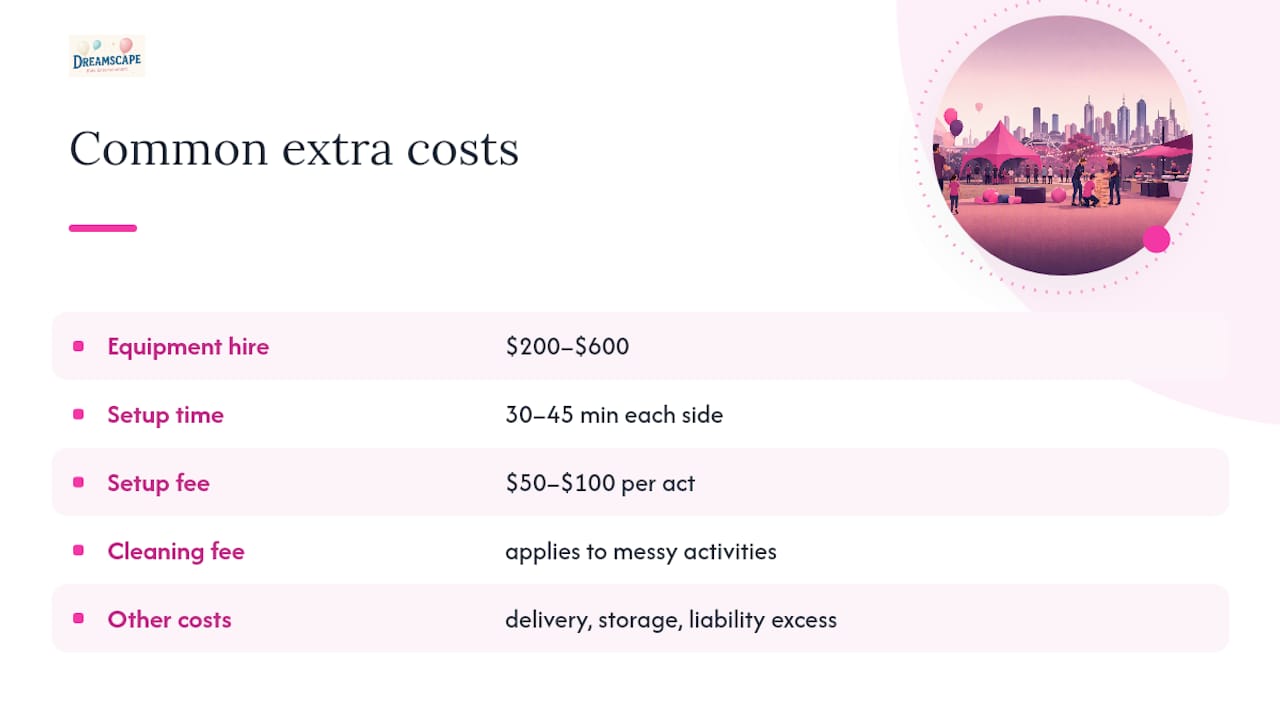
The number a supplier gives you upfront rarely covers everything you’ll actually pay for. Equipment hire beyond a performer’s standard kit, extra speakers, a generator for a powerless outdoor site, staging for a show act, is usually itemised on top of the base fee, and can add $200 to $600 depending on scale.
Setup and teardown fees catch planners out most often. A performer quoted for “two hours” is being paid for performance time, not the 30 to 45 minutes they need either side to arrive, set up, and pack down. Some suppliers fold this into the headline rate; others charge it separately at $50 to $100 per act. Always ask which model you’re getting quoted under.
Cleaning fees apply mainly to messier activities: face painting stations that leave residue on flooring, soft-play equipment that needs sanitising between sessions, or any activity zone set up on a venue’s carpeted areas. Venues themselves sometimes pass this cost through as a flat line item rather than the entertainment supplier.
Other costs worth checking for before you sign: public liability excess if something is damaged, delivery fees for larger inflatable equipment, and storage or holding fees if bump-in happens a day ahead of the event. None of these are hidden in a dishonest sense, they’re standard industry practice, but they rarely appear on a one-line quote summary unless you specifically ask for an itemised breakdown.
The safest habit is to request a full line-item quote before comparing suppliers, not just a bottom-line figure. Two quotes at the same headline price can differ by hundreds of dollars once setup, teardown, and cleaning are added back in.
Metro Melbourne vs suburban and regional pricing
Entertainment costs in the Melbourne CBD and inner suburbs sit at the top of the market, largely because that’s where supplier density is highest and demand competes hardest during peak periods. A roving performer or DJ based in the inner city rarely charges a travel fee for a booking within about 20 kilometres of the CBD.
Move further out, to the outer eastern suburbs, Mornington Peninsula, or Yarra Valley, and travel surcharges typically start appearing once you’re 40 to 50 kilometres from the city centre. These usually add $50 to $150 to a quote, sometimes scaled by vehicle trips if a supplier needs to bring extra equipment.
Regional Victorian venues, further out again toward Geelong, Ballarat, or Gippsland, often see travel costs climb to $150 to $400 depending on distance, and some suppliers charge for travel time itself rather than just fuel. The trade-off is that regional venue hire is frequently cheaper, which can offset the higher entertainment travel cost when you total the whole event budget.
The practical implication for planners is straightforward: don’t assume a regional venue is automatically the cheaper option once entertainment travel gets factored in. Run the full comparison, venue hire plus entertainment plus travel, rather than comparing entertainment quotes in isolation. A Melbourne-based supplier roster, which most established entertainment companies maintain, keeps travel costs lower and predictable regardless of which side of the city your event lands on.
Building in a contingency buffer
Weather is the single biggest unplanned cost driver for outdoor family days in Melbourne, a city known for shifting conditions within a single afternoon. Budget a contingency line of 10 to 15% of total entertainment spend specifically for weather-related changes, marquee hire booked at short notice, moving an outdoor show indoors, or a last-minute change to an activity zone that can’t operate in rain.
Sound budgeting practice treats an emergency fund as a standard line item alongside venue, entertainment, and catering, not an afterthought added if money’s left over. That’s the right instinct: a contingency line built in from the start survives a finance review far better than a request to add funds after the fact.
Beyond weather, common last-minute changes include a performer illness requiring a substitute (ask your supplier what their backup process looks like before you sign), a guest count that shifts by 10 to 20% close to the date, and venue-imposed changes like a reduced load-in window. None of these are avoidable entirely, but a written contract that spells out substitution rights and a contingency line that isn’t zero will absorb most of them without derailing the budget.
Where planners get this budget wrong
Most guides to corporate family day entertainment treat pricing as a shopping list, roving performer here, DJ there, add them up, done. That misses the part that actually determines whether an event stays on budget: the sequencing of decisions, not just the line items.
The planners who come in under budget aren’t the ones who found the cheapest performer. They’re the ones who locked their date early enough to skip peak season surcharges, then built their run-sheet before requesting quotes, so every supplier was pricing against a fixed scope instead of a vague brief. Fixing scope first is the single highest-leverage move in this entire process, and it costs nothing.
Conventional advice tends to overweight per-act haggling and underweight contingency planning. A weather buffer that doesn’t exist, on a day it’s needed, is a five-figure scramble for marquee hire at short notice. Prioritise the buffer and the written scope before you spend energy negotiating $50 off a face painting station.
If there’s one thing worth doing differently from how most planners approach this: request itemised quotes from the start. A bottom-line number hides exactly the costs, setup fees, cleaning, overtime triggers, that turn a good quote into a budget blowout three weeks later.
- Lauren
Get a tailored quote for your corporate family day
Some entertainment providers put together corporate family day packages across Melbourne built around your actual guest mix, not a generic template, drawing on extensive local experience and a roster where every entertainer holds a current Working With Children Check.
When you reach out for a quote, include your expected guest numbers, the rough age split between children and adults, your venue and date, and a target budget range. That’s enough for Dreamscape to put together a package, whether that’s a single roving character and face painting station for a smaller gathering or a full staged show with multiple activity zones for a large-scale event, and to flag any travel or venue considerations upfront rather than as a surprise on the invoice. Browse the character and theme options to get a sense of what’s available, then head to the corporate entertainment page to request a tailored quote for your event date.
Sources
- Education
- How to book entertainment for a corporate event | Australian Network Entertainment
- Ultimate guide to corporate DJ hire in Melbourne - One Click Events
- How to manage your corporate event budget | Melbourne Entertainment Company
FAQ
How much does entertainment cost for a corporate family day in Melbourne?
Expect to budget roughly $35 to $70 per guest depending on the entertainment mix, with roving performers and face painting at $200 to $450 per hour and staged show acts running from around $1,500 to $8,000 plus GST depending on the act’s profile.
What’s the cheapest way to cut entertainment costs?
Book Melbourne-based performers to avoid travel surcharges, bundle multiple acts with one supplier, and fix your scope and duration in writing before requesting quotes so suppliers price against a firm brief rather than a vague one.
Do entertainers need a Working With Children Check in Victoria?
Yes. Every performer working directly with children in Australia needs a valid Working With Children Check, and planners should confirm the number in writing before booking, not just accept a verbal assurance.
How far in advance should I book entertainment?
Book at least six to eight weeks ahead for a standard event, and 12 or more weeks out for bespoke shows or bookings during school holidays and December, when demand and pricing both peak.
What hidden costs catch planners out most often?
Setup and teardown time charged separately from performance hours, equipment hire beyond a supplier’s standard kit, and cleaning fees for messier activities like face painting or soft-play are the three most commonly missed costs on a headline quote.
Recommended
Planning a Melbourne party?
We will get right back to you.